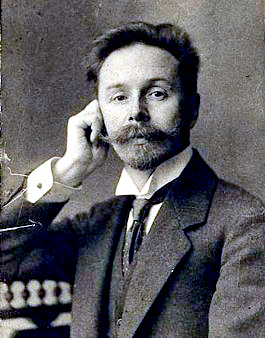
Alexander Scriabin
Italiano in fondo alla pagina
Alexander Nikolayevich Scriabin (Russian: Алекса́ндр Никола́евич Скря́бин) was a Russian pianist and composer who was much influenced by Theosophy and by the Symbolist movement in the visual arts.
Theosophist Margaret Cousins, a concert pianist, wrote: “His music has constantly in it a most poignant sweet quality which seems to pierce to the holy of holies of one’s being.”[1]
Contents
[hide]
Personal life
Childhood and education
Alexander Scriabin was born in Moscow on December 25, 1871, according to the Julian Calendar, or January 6, 1872 in the Gregorian Calendar that is now in use. His family was aristocratic, with a strong tradition of all male members being in the military, but his father, Nikolai Alexandrovich, took a different direction, training as a lawyer and becoming a minor diplomat.

Scriabin as cadet
The family name derives from “skriba” or “scribe,” and has been transliterated in many ways – Scriabine, de Scriabine, Skriabin, Skrjabin, Skryabin.[2]
Nilolai Scriabin married Lyubox Petrovna Shchetinina, a concert pianist, protegée of Anton Rubinstein, and winner of the Great Gold Medal from the Petersburg Conservatory. She died of tuberculosis within months after Alexander’s birth. Bowers (1969) Volume I, 105-107.</ref>
Young Alexander’s father was mostly absent in diplomatic postings, so the boy, called “Sasha” or “Shurinka,” was raised in the household of his grandmother, his great-aunt, and his father’s unmarried sister Lyubov Alexandrova Scriabina. The aunt, an amateur pianist, nurtured Sasha’s creativity. Even without formal training, Alexander could play complex tunes on the piano by ear. At age seven, he constructed ten toy pianos with strings, sounding boards, working pedals, and moving keys. He read adult literature, designed patterns for needlework, and wrote short plays.[3]
Nikolai Scriabin remarried and had four more sons and a daughter, but his oldest son continued to live with his aunt Lyubov. Alexander attended the Cadet Corps school, and had a difficult time with hazing and bullying until his skill at the piano made him indispensable at social events. He began composing, and began to have formal music lessons during the summers. In 1885, he was began a five-year program of training at the prestigious Moscow Conservatory, learning theory, solfeggio, harmony, and counterpoint.[4] In 1892 he began to sell his compositions.
As a youth, and throughout his life, Scriabin was physically small and weak; sensitive and volatile; easily bored; and fragile in health. His right hand was susceptible to strain from overworking it, especially after an injury in 1891. He developed an unusually strong and independent left hand technique as a result, and wrote music for the left hand alone.[5]
Marriage and parenthood
In December, 1893, Scriabin was introduced to Vera Ivanovna Isakovich (1875-1920), a talented pianist. When he was 25 years old, they married in a formal 5-day Russian Orthodox ceremony from August 15-20, 1897.[6] The couple performed together often – individually, and in arrangements for four hands. They had four children, putting pressure on Scriabin to work at teaching at the Moscow Conservatory in addition to his performances and composing. The family continually struggled to make ends meet.
Scriabin abandoned his family and separated from Vera in 1904. She eventually agreed to a divorce, and he married Tatiana Fyodorovna Schlözer, with whom he had three more children. They lived in various European cities, in self-imposed exile.[7]
Later years
Scriabin visited London in 1914. He wrote on March 24 that he planned to dine with Theosophists, hosted by a man named Weed who had been a secretary of the Society for 32 years. “At his house I will meet the woman in whose arms [Madame] Blavatsky died. The dinner promises me much.”[8]
It was in London that Scriabin became ill. It began with a pimple on his upper lip under his moustache. The pimple was infected with staphylococcus blood poisoning. The illness led to his death. Tatiana and the children were left with little money and Rachmaninov, among others, came to their aid.[9]
On April 2, 1915, Scriabin performed his final recital in St. Petersburg. He died on April 27, 1915 (or April 14 by Julian Calendar). His friend Sergei Rachmaninov went on a concert tour devoted to Scriabin’s music to raise funds for the family.

Scriabin writing
Musical career
Music publisher Mitrofan Belaieff was Scriabin’s mentor and guide in the music world. He supported the composer financially for many years and continually importuned him to complete compositions. Scriabin usually had several musical pieces in various states of incompleteness, and many might never have been published without external pressure. Belaieff could be generous, miserly, petulant, and nurturing in turns to elicit work from the often lazy and distracted composer.
In the first phase of his career, his compositions were much influenced by the Romantic music of Chopin and Robert Schumann. In his piano concerts, he had the skill to perform any of the musical literature of the day. His technique of touching the keys, his expressiveness, and his sophisticated use of pedals achieved unusual effects. After Scriabin began composing, he mostly performed his own pieces.[10]
Pianist Anthony Hewitt recorded all of Scriabin’s preludes and wrote of that experience,
There are of course many facets and joys in such a project, but one of the aspects I found most fascinating was to trace the development in Scriabin’s style, from lavish romanticism in the early Preludes, to the bleak vulnerability and stark atonality in the later ones. He stretched the boundaries of tonality, and has sadly been given little credit for it.
If there is one element which I found encompasses the whole span of Preludes, irrespective of style, it’s the sense of tonality as a means of conveying colour and mood, and latterly atonality and dissonance playing a key part in communicating a very specific emotion, often one of rage or violence, unresolved tension, and an accompanying mystical element…
By the time we arrive at Opus 48, atonality is becoming the dominant musical language. Interestingly at this juncture, Scriabin stops using metronome markings and tempo indications, replacing them with idiosyncratic directions: “Con Stravaganza”, “Festivamente”, “Poetico con delizio” (poetic and with delight), “Bellicoso” (war-like)… He is very specific in the states of mind needed to capture the spirit…
it’s remarkable to think that Scriabin wrote so many Preludes, all of which are completely different; testament to his limitless imagination.[11]

Circle of Fifths
Scriabin associated colors with musical tones, characteristic of synesthesia. He developed a color-coded circle of fifths that was influenced by Theosophical thought. The fifth symphony, Prometheus, was completed in 1910. It was scored for a large orchestra and chorus, plus a clavier à lumières, a keyboard instrument designed to trigger lights corresponding with certain chords.
Unfortunately, the clavier a lumieres existed only in theory when its part was written by Scriabin. The first performance of Prometheus was given without it in Moscow in 1911, and it wasn’t performed with lights until the New York concert in 1915. Even then the lights were just projected on a screen which is not what Scriabin had in mind. He had wanted powerful flashing colors to fill the concert hall and dazzling, almost blinding white light at the climactic end.[12]
At the time of his death in 1915, he was working on his most ambitious composition – the Mysterium. His goal was no less than the spiritual growth and even enlightenment of the audience in a performance that would take place for seven days.:
For Scriabin, it was precisely the ecstatic, Dionysian powers of music that he conjured in his symphonic works like Poem of Fire (1909 -10) and Poem of Ecstacy (1917) that were of most importance. Scriabin developed a “mystic chord” of superimposed fourths and, like Wagner, believed in the “total art work.” He saw music as a means of transforming humanity by hurrying on its spiritual evolution. His last years were spent in planning a gargantuan Mystery drama, combining music, dance, theatre, poetry, ritual, and even incense in an attempt to create a synthesis of the sensual and spiritual and inaugurate a New Age. Scriabin’s “Mystery” was to be performed in a hemispherical temple in India, inducing a supreme ecstasy that would dissolve the physical plane and start a metaphysical chain reaction eventually enveloping the world. Scriabin introduced many Theosophical ideas into his compositions and also experimented with “synesthesia,” the strange experience of “hearing colors” and “seeing music,” going so far as to devise a organ that would project different colored lights that he associated hermetically with different notes and chords.[13]
The composer was held in high esteem during his lifetime both as a pianist and for his compositions. He won the prestigious and lucrative Glinka Award in 1898, 1899, 1900, and 1903.[14]Today his work can be viewed as a transition from the Romantic Period into the 20th century. English composer Cyril Scott, a Theosophist, offered another perspective of Scriabin’s music:
Various forms of pantheism, including Eastern religions and theosophy, propose that nature has an indwelling intelligence. Scriabin’s harmonic system, especially Prometheus, therefore has an almost inhuman quality about it. Scott says that Scriabin was not under the supervision and protection of a spiritual teacher and that his mysterious death from a pimple was due to his inability to handle the strain he was under from contacting the higher intelligence of nature.[15]
Theosophical Society connections
A young friend the Viscount de Gissac asked Scriabin to lecture and write in French, but the composer declined, claiming that his knowledge of French was insufficient. Studying Theosophical literature in French improved his proficiency, so that eventually Scriabin used French notation in his musical compositions.
In Paris in early 1905, de Gissac gave Scriabin a copy of La Clef de la Théosophie, the French translation of Helena Blavatsky’s book The Key to Theosophy (1889) which Scriabin described in a letter of April/May 1905 as a remarkable book and astonishingly close to his own thinking. From that time on, more and more of Scriabin’s circle of friends were drawn from the French and Belgian branches of the Theosophical Society, most notably the painter Jean Delville with whom Scriabin became associated when he relocated to Brussels in 1908. It has been suggested that Scriabin enrolled into formal membership of its Belgian branch at this time, and that Delville may have introduced him to the Sons of the Flames of Wisdom, a secret Promethean cult within Theosophy, but solid documentary evidence for this has yet be produced. Both Leonid Sabaneev and Boris Schloezer later recalled that a French translation of Blavatsky’s book The Secret Doctrine (1888) was always on Scriabin’s work table. It was clear that Scriabin had studied La Doctrine Secrète with great care as he had annotated and underlined in pencil what he considered to be the most important passages. Scriabin also subscribed to Le Lotus Bleu, a monthly francophone theosophical journal, during the period 1904–9 inclusive; this observation can help to account for the presence of the expressive French musical directions in Le Divin Poème, Op.43 (1904). Taken altogether, it is clear that Scriabin carefully studied a very considerable amount of theosophical literature in French during 1904–1909 while he was resident outside Russia, and this would undoubtedly have improved his capacity to express his esoteric, occultist and mystical intentions for his music.
… In addition to the two French texts by Blavatsky and the monthly copies of Le Lotus Bleu mentioned above, Scriabin also had French translations of Auguste Barth’s The Religions of India and Edwin Arnold’s The Light of Asia in his bookcase. Furthermore, from 1911 onwards in Moscow Scriabin subscribed to three theosophical journals including the francophone monthly periodical Revue Théosophique Belge.[16]
Scriabin wrote in May, 1905 to a friend that “La Clef la Théosophie is a remarkable book. You will be astonished at how close it is to my thinking.”[17] He began to blend together Theosophical concepts with the native symbolism of the Russian Silver Age artists and writers as he wrote expressive directions for works such as the Preparatory Act of the Mysterium.[18]
[In 1906] Scriabin’s conversations were full of theosophy and the personality of Blavatsky. he wanted to return to Russia where Theosophy had even more of a vogue than abroad. Even with the exposure of Blavatsky’s occultism, which appeared headlined in every newspaper of the world, Scriabin was “unshaken… He attributed the exposés to personal grievances on the part of one member or other in the Theosophical movement.”[19]
James Cousins wrote of “Sacha Scriabine of Russia who died in 1915 before he could complete his ambition of setting The Secret Doctrire to music (not literally but in spirit).”[20]
Simon Nicholls, editor of an Oxford University Press book on the composer, wrote ” Indeed Skryabin was deeply interested by Mme Blavatsky’s ideas for the last ten years of his life. I have sat in the Skryabin Museum in Moscow and looked at one of the volumes of The Secret Doctrine in the French version, with Skryabin’s carefully ruled underlinings and pencilled comments, many of them.”[21]

Cover by Jean Delville for Prometheussymphony
Theosophical influence in Prometheus symphony
Prometheus, “The Poem of Fire,” Opus 60, was Scriabin’s fifth and last symphony, written in 1909-1910. It was scored massively, with prominent piano and chorus, and was planned to be performed with a “color organ,” which would project appropriate colors on a screen synchronized with the music.
Dr. James Cousins wrote an account of how this symphony written, that he heard while visiting the composer with his wife Margaret Cousins, in the suburbs of Brussels:
When Scriabine was a very young man, already noted as a composer and pianist, he went to Brussels, and there, among the younger group of artists in various mediums, he met Jean Delville. The two were attracted to one another. Scriabine noticed something in Delville that he himself lacked: Scriabine was groping towards some kind of comprehension of life. He asked Delville, in the same room where we heard the story, what was behind his attitude to life, and how he, the questioner, could reach a similar attitude. Delville produced two large volumes and put them before Scriabine. “Read these – and then set them to music,” he said. Scriabine read the books – The Secret Doctrine. He went on fire with their revelation. The result was his immortal masterpiece, “Prometheus.”… While Scriabine composed the Symphony, he came excitedly at intervals into Delville’s drawing-room and played for the painter the musical ideas that were crowding in on him. At the same time Delville painted his wonderful picture of Prometheus falling from the sky with the gift of fire for the earth. He showed us the great canvas in his studio. It almost came to India. [i.e. to the Theosophical Society headquarters in Adyar.][22]
Scriabin’s biographer added:
He [Scriabin] adored the cover design of his Prometheus symphony. It showed a sexless face surrounded by cosmic symbols, nebulae of clouds, spiraling comets, and was drawn by his Belgian friend, Jean Delville (b. 1867), a bachelor, professor of Fine Arts at the Royal Academy, and President of the national Federation of Artists and Sculptors. Looking at that cover of the androgyne or hermaphrodite, Scriabin said, “In those ancient races, male and female were one… the separation into poles hadn’t yet taken place…[23]
Prometheus as a plot reeks of Theosophical symbolism and is Scriabin’s only composition so heavily inflated with such paraphernalia. It exhales Brussels and the dense, mystical air of that city. Delville’s cover design for the score shows a lyre (“the World,” symbolized by music) rising from a lotus bloom (“the Womb,” mind or Asia). In the center over the Star of David is Prometheus’s face (“really the ancient symbol of Lucifer,” Scriabin said, encompassing all religions). Delville, and perhaps Scriabin, had joined a secret cult within Theosophy called “Sons of the Flames of Wisdom.” They worshiped Prometheus, because those fires, colors, lights were metasymbols of man’s highest thoughts. Fire was Prometheus’s stolen gift to man, and it lay deep within hearts…
To Scriabin, Prometheus had further symbolism beyond Theosophy’s haziness. Lucifer was the “Light Bringer,” according to the Christian Bible, and Satan was the “Disobedient Rebel.” Sabaneeff’s program notes… state that “Prometheus, Satanas, and Lucifer all meet in ancient myth. They represent the active energy of the universe, its creative principle. The fire is light, life, struggle, increase, abundance, and thought. At first, this powerful force manifests itself wearily, as languid thirsting for life. Within this lassitude then appears the primordial polarity between soul and matter. Later it does battle and conquers matter – of which it itself is a mere atom – and returns to the original quiet and tranquillity … thus completing the cycle…”[24]
Musical compositions
Most of Scriabin’s work was for piano in the usual forms – études, preludes, nocturnes, sonatas, mazurkas, etc. His orchestral works are fewer, but among the most popular.
Kurt Leland writes,
Among Scriabin’s mystically inclined works for orchestra are the Poem of Ecstasy, which depicts the union of male and female principles that continually recreates the universe…
Scriabin also composed ten piano sonatas, several of which have Theosophical subtexts. The Fourth Sonata is about flight toward a star, as in the experience of astral projection. The Seventh, subtitled White Mass, is about the mystical forces unleashed in a magical ceremony, and the Ninth (Black Mass) is about purging the corresponding dark forces. The Eighth Sonata uses five musical fragments to represent the constant interplay of the elements earth, water, air, fire, and, as he called it, “the mystical ether.”
Scriabin’s Tenth Sonata portrays solar insects “born from the sun,” “the sun’s kisses.” The radiant halo of trills with which the piece closes is one of the most effective depictions in music of the inner light associated with high meditative states, such as samadhi.[25]
For a complete list of the composer’s works, see List of compositions by Alexander Scriabin. Here are some favorites:
Orchestral works

Scriabin at his last recital. By B. Kustodiev
- Symphonic Poem in D minor. 1896.
- Piano Concerto in F-sharp minor, Op. 20. 1896.
- Symphony No. 1 in E major, Op. 26. 1900.
- Symphony No. 2 in C minor, Op. 29. 1901.
- Symphony No. 3 in C minor, Op. 43. The Divine Poem. 1904.
- The Poem of Ecstasy, Op. 54. Fourth Symphony. 1908.
- Prometheus: The Poem of Fire, Op. 60. Fifth Symphony. 1910.
Piano works
- Étude in C-sharp minor, No. 1 from Trois morceaux, Op. 2. 1887.
- 12 Études, Op. 8. 1894.
- 8 Études, Op. 42. 1903.
- Fantaisie in B minor, Op. 28. 1900. Sonata form.
- Impromptu à la Mazur in C major, No. 3 from Trois morceaux, Op. 2.
- Vers la flamme, Op. 72.
- 24 Preludes, Op. 11. 1896.
- Sonata-Fantaisie in G-sharp minor. 1886.
- Sonata No. 7 “White Mass”, Op. 64.
Scriabin Museum
The Alexander Scriabin Memorial Museum was established on July 17, 1922 to preserve the apartment where the composer lived for his final three years, in an old mansion on Arbat Street in Moscow. The composer’s prized possessions were carefully restored, including his copy of The Secret Doctrine.[26] The museum preserves Scriabin’s library, letters, sheet music, and other items.
Additional resources
The Union Index of Theosophical Periodicals lists articles about Scriabin.
- Alexander Scriabin Natal Horoscope at Khaldea.
- Blavatsky, Scriabin and Music at Blavatsky News 2.0
- Hull, A. Eaglefield. Scriabin. London: Kegan Paul, 1927.
- Sabbagh, Peter. The Development of Harmony in Scriabin’s Works. 2003.
- Swan, Alfred J. Scriabin. London: John Lane, 1923.
Notes
- Jump up↑ Margaret Cousins, “Memorabilia of Scriabine – the Master Musician of Theosophy,” The Theosophist 56 (November 1934), 173.
- Jump up↑ Faubion Bowers, Scriabin: A Biography of the Russian Composer 1871-1915, Volume I (Tokyo:Kodansha International Ltd, 1969), 109-112.
- Jump up↑ Bowers (1969) Volume I, 109-112.
- Jump up↑ Bowers (1969) Volume I, 141.
- Jump up↑ Bowers (1969) Volume I, 150, 182-183.
- Jump up↑ Bowers (1969) Volume I, 242.
- Jump up↑ “Prominent Russians: Aleksandr Scriabin” in Russiapedia. Accessed October 23, 2016.
- Jump up↑ Bowers (1969) Volume I, 258.
- Jump up↑ “Prominent Russians: Aleksandr Scriabin” in Russiapedia. Accessed October 23, 2016.
- Jump up↑ Simon Nicholls, “On the track of Scriabin as Pianist” at Scriabin Association website.
- Jump up↑ Anthony Hewitt, “The Development of Dissonance in Scriabin’s Piano Preludes” at Scriabin Association website.
- Jump up↑ Gary Brown, “Music as Magic: Composer Alexander Scriabin” The American Theosophist 70.5 (May 1982), 157.
- Jump up↑ Gary Lachman, “Concerto for Magic and Mysticism: Esotericism and Western Music.” The Quest 90.4 (July-August, 2002), 132-137.
- Jump up↑ Bowers (1969) Volume I,261, 272, 304.
- Jump up↑ Cyril Scott, Music: Its Secret Influence Throughout the Ages (New York: Samuel Weiser Inc., 1958).
- Jump up↑ Richard E. Overill, Alexander Scriabin’s Use of French Directions to the Pianist at Scriabin Association web page.
- Jump up↑ Bowers(1969) Volume II, 52.
- Jump up↑ Richard E. Overill, Alexander Scriabin’s Use of French Directions to the Pianist at Scriabin Association web page.
- Jump up↑ Bowers (1969) Volume II, 117.
- Jump up↑ James H. Cousins, “The Life and Work of Jean Delville, Theosophist Painter-Poet.” The Theosophist47.3 (December 1925), 396.
- Jump up↑ Simon Nicholls email to Leslie Price and Janet Kerschner. July 19, 2017.
- Jump up↑ “Scriabine and Delville,” The Theosophist 57.4 (January 1936), 358.
- Jump up↑ Faubion Bowers, Scriabin: a Biography, Second, Revised edition (New York: Dover, 1996), 71.
- Jump up↑ Bowers (1969) Volume II, 206-207.
- Jump up↑ Kurt Leland, “Theosophical Music” Quest 99.2 (Spring, 2011): 61-64. Available at Quest website.
- Jump up↑ Bowers (1969) Volume I, 87.
| Alexander Scriabin | |
|---|---|
 |
|
| Born | December 25, 1871 Moscow, Russian Empire |
| Died | April 14, 1915 (aged 42) Moscow, Russian Empire |
| Occupation | Pianist |
| Era | 20th century |
| Notable work | List of compositions by Alexander Scriabin |
| Spouse(s) | Tatiana Fyodorovna Schlözer |
| Children | Ariadna Scriabina, Julian Scriabin |
Alexander Nikolayevich Scriabin[1] (English: /skriˈɑːbɪn/;[2] Russian: Алекса́ндр Никола́евич Скря́бин, Russian pronunciation: [ɐlʲɪˈksandr nʲɪkəˈlaɪvʲɪtɕ ˈskrʲæbʲɪn][citation needed]; 6 January 1872 [O.S. 25 December 1871] – 27 April [O.S. 14 April] 1915)[3] was a Russian composer and pianist. Scriabin, who was influenced early in his life by the works of Frédéric Chopin,[4] composed works that are characterised by a highly tonal idiom (these works are associated with his “first stage” of compositional output). Later in his career, independently of Arnold Schoenberg, Scriabin developed a substantially atonal and much more dissonant musical system, which accorded with his personal brand of mysticism.[citation needed] Scriabin was influenced by synesthesia, and associated colours with the various harmonic tones of his atonal scale, while his colour-coded circle of fifths was also influenced by theosophy. He is considered by some to be the main Russian Symbolist composer.
Scriabin was one of the most innovative and most controversial of early modern composers. The Great Soviet Encyclopedia said of Scriabin that, “No composer has had more scorn heaped on him or greater love bestowed.” Leo Tolstoy described Scriabin’s music as “a sincere expression of genius.”[5] Scriabin had a major impact on the music world over time, and influenced composers such as Igor Stravinsky, Sergei Prokofiev,[6] and Nikolai Roslavets. However Scriabin’s importance in the Russian and then Soviet musical scene, and internationally, drastically declined after his passing. According to his biographer Bowers, “No one was more famous during their lifetime, and few were more quickly ignored after death.”[7] Nevertheless, his musical aesthetics have been reevaluated, and his ten published sonatas for piano, which arguably provided the most consistent contribution to the genre since the time of Beethoven’s set, have been increasingly championed.[8]
Alexander Scriabin
Alessandro Scriabin
Alexander Nikolaevich Scriabin (russo: Алекса́ндр Никола́евич Скря́бин) è stato un pianista e compositore russo molto influenzato dalla Teosofia e dal movimento simbolista nelle arti visive.
La teosofa Margaret Cousins, pianista da concerto, ha scritto: “La sua musica ha costantemente una qualità dolce e struggente che sembra penetrare nel sacro dei santi del nostro essere”[1].
Contenuti
1 Vita personale
1.1 Infanzia e formazione
1.2 Il matrimonio e la paternità
1.3 Gli ultimi anni
2 Carriera musicale
3 Legami con la Società Teosofica
4 L’influenza teosofica nella Sinfonia di Prometeo
5 Composizioni musicali
5.1 Opere orchestrali
5.2 Opere per pianoforte
6 Museo Scriabin
7 Risorse aggiuntive
8 Note
Vita privata
Infanzia e formazione
Alexander Scriabin nacque a Mosca il 25 dicembre 1871, secondo il calendario giuliano, o il 6 gennaio 1872 secondo il calendario gregoriano attualmente in uso. La sua famiglia era aristocratica, con una forte tradizione di tutti i membri maschi nell’esercito, ma suo padre, Nikolai Alexandrovich, prese una direzione diversa, formandosi come avvocato e diventando un piccolo diplomatico.
Scriabin come cadetto
Il nome della famiglia deriva da “skriba” o “scriba” ed è stato traslitterato in molti modi: Scriabine, de Scriabine, Skriabin, Skrjabin, Skryabin.[2]
Nilolai Scriabin sposò Lyubox Petrovna Shchetinina, concertista, protegée di Anton Rubinstein e vincitrice della Grande Medaglia d’Oro del Conservatorio di Pietroburgo. Morì di tubercolosi pochi mesi dopo la nascita di Alexander. Bowers (1969) volume I, 105-107.
Il padre del giovane Alessandro era per lo più assente per impegni diplomatici, così il ragazzo, chiamato “Sasha” o “Shurinka”, fu allevato dalla nonna, dalla prozia e dalla sorella nubile del padre, Lyubov Alexandrova Scriabina. La zia, pianista dilettante, alimentò la creatività di Sasha. Anche senza una formazione formale, Alexander era in grado di suonare a orecchio melodie complesse al pianoforte. All’età di sette anni costruì dieci pianoforti giocattolo con corde, tavole armoniche, pedali funzionanti e tasti mobili. Leggeva letteratura per adulti, disegnava modelli per il cucito e scriveva brevi opere teatrali.[3]
Nikolai Scriabin si risposò ed ebbe altri quattro figli e una figlia, ma il figlio maggiore continuò a vivere con la zia Lyubov. Alexander frequentò la scuola del Corpo dei Cadetti, e dovette affrontare non pochi problemi di nonnismo e bullismo, finché la sua abilità al pianoforte lo rese indispensabile agli eventi sociali. Iniziò a comporre e a prendere lezioni di musica durante l’estate. Nel 1885 iniziò un programma di formazione di cinque anni presso il prestigioso Conservatorio di Mosca, imparando teoria, solfeggio, armonia e contrappunto.[4] Nel 1892 iniziò a vendere le sue composizioni.
Da giovane, e per tutta la vita, Scriabin era fisicamente piccolo e debole, sensibile e volubile, si annoiava facilmente e aveva una salute fragile. La sua mano destra era soggetta a sforzi eccessivi, soprattutto dopo un infortunio nel 1891. Di conseguenza, sviluppò una tecnica insolitamente forte e indipendente per la mano sinistra e scrisse musica per la sola mano sinistra.[5]
Il matrimonio e la paternità
Nel dicembre 1893, Scriabin fu presentato a Vera Ivanovna Isakovich (1875-1920), una pianista di talento. All’età di 25 anni, i due si sposarono con una cerimonia formale ortodossa di 5 giorni dal 15 al 20 agosto 1897.[6] La coppia si esibì spesso insieme, sia individualmente che in arrangiamenti a quattro mani. Ebbero quattro figli e Scriabin fu costretto a lavorare come insegnante al Conservatorio di Mosca, oltre che a esibirsi e a comporre. La famiglia faticava continuamente a sbarcare il lunario.
Scriabin abbandonò la famiglia e si separò da Vera nel 1904. Alla fine accettò il divorzio e sposò Tatiana Fëdorovna Schlözer, dalla quale ebbe altri tre figli. I due vissero in varie città europee, in un esilio autoimposto.[7]
Gli anni successivi
Scriabin visitò Londra nel 1914. Il 24 marzo scrisse che aveva intenzione di cenare con i teosofi, ospitati da un uomo di nome Weed che era stato segretario della Società per 32 anni. “A casa sua incontrerò la donna tra le cui braccia [Madame] Blavatsky è morta. La cena mi promette molto”[8].
Fu a Londra che Scriabin si ammalò. La malattia iniziò con un brufolo sul labbro superiore, sotto i baffi. Il brufolo fu infettato da un avvelenamento da stafilococco. La malattia lo portò alla morte. Tatiana e i bambini rimasero con pochi soldi e Rachmaninov, tra gli altri, venne in loro aiuto.[9]
Il 2 aprile 1915 Scriabin eseguì il suo ultimo recital a San Pietroburgo. Morì il 27 aprile 1915 (o il 14 aprile secondo il calendario giuliano). Il suo amico Sergei Rachmaninov intraprese un tour di concerti dedicati alla musica di Scriabin per raccogliere fondi per la famiglia.
Scrittura di Scriabin
Carriera musicale
L’editore musicale Mitrofan Belaieff fu il mentore e la guida di Scriabin nel mondo della musica. Egli sostenne finanziariamente il compositore per molti anni e lo sollecitò continuamente a completare le composizioni. Scriabin aveva di solito diversi pezzi musicali in vari stati di incompletezza, e molti non sarebbero mai stati pubblicati senza una pressione esterna. Belaieff sapeva essere generoso, avaro, petulante e accudente a turno per stimolare il lavoro del compositore, spesso pigro e distratto.
Nella prima fase della sua carriera, le sue composizioni furono molto influenzate dalla musica romantica di Chopin e Robert Schumann. Nei suoi concerti per pianoforte, aveva la capacità di eseguire qualsiasi letteratura musicale dell’epoca. La sua tecnica di toccare i tasti, la sua espressività e il suo sofisticato uso dei pedali ottenevano effetti insoliti. Dopo aver iniziato a comporre, Scriabin eseguì per lo più i suoi pezzi.[10]
Il pianista Anthony Hewitt ha registrato tutti i preludi di Scriabin e ha scritto di questa esperienza,
Ci sono naturalmente molte sfaccettature e gioie in un progetto del genere, ma uno degli aspetti che ho trovato più affascinanti è stato quello di tracciare l’evoluzione dello stile di Scriabin, dallo sfarzoso romanticismo dei primi Preludi, alla cupa vulnerabilità e alla cruda atonalità di quelli successivi. Scriabin si è spinto oltre i confini della tonalità e purtroppo gli è stato dato poco credito per questo.
Se c’è un elemento che, a mio avviso, abbraccia l’intero arco dei Preludi, indipendentemente dallo stile, è il senso della tonalità come mezzo per trasmettere il colore e l’umore, e in ultimo l’atonalità e la dissonanza che giocano un ruolo chiave nel comunicare un’emozione molto specifica, spesso di rabbia o di violenza, di tensione irrisolta e di un elemento mistico che l’accompagna…
Quando arriviamo all’Opus 48, l’atonalità diventa il linguaggio musicale dominante. È interessante notare che in questo frangente Scriabin smette di usare i segni del metronomo e le indicazioni di tempo, sostituendoli con indicazioni idiosincratiche: “Con Stravaganza”, “Festivamente”, “Poetico con delizio”, “Bellicoso”… È molto preciso negli stati d’animo necessari per catturare lo spirito…
è notevole pensare che Scriabin abbia scritto così tanti Preludi, tutti completamente diversi tra loro, a testimonianza della sua illimitata immaginazione.[11]
Il cerchio delle quinte
Scriabin associava i colori ai toni musicali, caratteristica della sinestesia. Sviluppò un cerchio di quinte codificato per colore, influenzato dal pensiero teosofico. La quinta sinfonia, Prometeo, fu completata nel 1910. Era prevista per una grande orchestra e un coro, oltre a un clavier à lumières, uno strumento a tastiera progettato per attivare luci corrispondenti a determinati accordi.
Purtroppo, il clavier à lumières esisteva solo in teoria quando la sua parte fu scritta da Scriabin. La prima esecuzione del Prometeo avvenne senza di esso a Mosca nel 1911, e non fu eseguito con le luci fino al concerto di New York del 1915. Anche allora le luci erano solo proiettate su uno schermo, il che non è ciò che Scriabin aveva in mente. Voleva colori potenti e lampeggianti per riempire la sala da concerto e una luce bianca abbagliante, quasi accecante, nel finale.[12]
Al momento della sua morte, avvenuta nel 1915, Scriabin stava lavorando alla sua composizione più ambiziosa: il Mysterium. Il suo obiettivo era nientemeno che la crescita spirituale e persino l’illuminazione del pubblico in una performance che si sarebbe svolta per sette giorni:
Per Scriabin, erano proprio i poteri estatici e dionisiaci della musica, che egli evocava nelle sue opere sinfoniche come il Poema del fuoco (1909-10) e il Poema dell’estasi (1917), a rivestire la massima importanza. Scriabin sviluppò un “accordo mistico” di quarte sovrapposte e, come Wagner, credeva nell'”opera d’arte totale”. Vedeva la musica come un mezzo per trasformare l’umanità, accelerandone l’evoluzione spirituale. I suoi ultimi anni furono dedicati alla progettazione di un gigantesco dramma del Mistero, che combinava musica, danza, teatro, poesia, rituali e persino incenso nel tentativo di creare una sintesi tra sensuale e spirituale e inaugurare una Nuova Era. Il “Mistero” di Scriabin doveva essere rappresentato in un tempio semisferico in India, inducendo un’estasi suprema che avrebbe dissolto il piano fisico e avviato una reazione a catena metafisica che avrebbe finito per avvolgere il mondo. Scriabin introdusse molte idee teosofiche nelle sue composizioni e sperimentò anche la “sinestesia”, la strana esperienza di “sentire i colori” e “vedere la musica”, arrivando a ideare un organo che proiettava diverse luci colorate che associava ermeticamente a diverse note e accordi.[13]
Durante la sua vita il compositore fu molto apprezzato sia come pianista che per le sue composizioni. Vinse il prestigioso e remunerativo Premio Glinka nel 1898, 1899, 1900 e 1903.[14]Oggi la sua opera può essere vista come una transizione dal periodo romantico al XX secolo. Il compositore inglese Cyril Scott, teosofo, ha offerto un’altra prospettiva della musica di Scriabin:
Varie forme di panteismo, tra cui le religioni orientali e la teosofia, propongono che la natura abbia un’intelligenza intrinseca. Il sistema armonico di Scriabin, in particolare Prometeo, ha quindi una qualità quasi inumana. Scott afferma che Scriabin non era sotto la supervisione e la protezione di un maestro spirituale e che la sua misteriosa morte per un brufolo fu dovuta alla sua incapacità di gestire la tensione che gli derivava dal contatto con l’intelligenza superiore della natura.[15]
Legami con la Società Teosofica
Un giovane amico, il visconte de Gissac, chiese a Scriabin di tenere conferenze e scrivere in francese, ma il compositore rifiutò, sostenendo che la sua conoscenza del francese era insufficiente. Lo studio della letteratura teosofica in francese migliorò la sua competenza, tanto che alla fine Scriabin utilizzò la notazione francese nelle sue composizioni musicali.
All’inizio del 1905, a Parigi, de Gissac regalò a Scriabin una copia de La Clef de la Théosophie, la traduzione francese del libro di Helena Blavatsky La chiave della Teosofia (1889) che Scriabin descrisse in una lettera dell’aprile/maggio 1905 come un libro straordinario e sorprendentemente vicino al suo pensiero. Da quel momento in poi, sempre più amici di Scriabin provengono dai rami francese e belga della Società Teosofica, in particolare il pittore Jean Delville, con il quale Scriabin si legò quando si trasferì a Bruxelles nel 1908. È stato ipotizzato che Scriabin si sia iscritto formalmente al ramo belga in questo periodo e che Delville possa averlo introdotto ai Figli delle Fiamme della Saggezza, un culto prometeico segreto all’interno della Teosofia, ma non sono ancora state prodotte prove documentali solide al riguardo. Sia Leonid Sabaneev che Boris Schloezer ricordarono in seguito che una traduzione francese del libro della Blavatsky La Dottrina Segreta (1888) era sempre sul tavolo di lavoro di Scriabin. È chiaro che Scriabin aveva studiato La Doctrine Secrète con grande attenzione, poiché aveva annotato e sottolineato a matita quelli che considerava i passaggi più importanti. Scriabin si abbonò anche a Le Lotus Bleu, una rivista teosofica mensile francofona, nel periodo 1904-9 compreso; questa osservazione può contribuire a spiegare la presenza delle espressive indicazioni musicali francesi in Le Divin Poème, Op.43 (1904). Nel complesso, è chiaro che Scriabin studiò attentamente una quantità considerevole di letteratura teosofica in francese durante il periodo 1904-1909, mentre risiedeva fuori dalla Russia, e questo avrebbe senza dubbio migliorato la sua capacità di esprimere le sue intenzioni esoteriche, occultiste e mistiche per la sua musica.
… Oltre ai due testi francesi della Blavatsky e alle copie mensili de Le Lotus Bleu di cui sopra, Scriabin aveva nella sua libreria anche le traduzioni francesi de Le religioni dell’India di Auguste Barth e de La luce dell’Asia di Edwin Arnold. Inoltre, a partire dal 1911 a Mosca Scriabin si abbonò a tre riviste teosofiche, tra cui il mensile francofono Revue Théosophique Belge.[16]
Nel maggio del 1905 Scriabin scrisse a un amico che “La Clef la Théosophie è un libro notevole. Ti stupirai di quanto sia vicino al mio pensiero”[17] Iniziò a fondere insieme i concetti teosofici con il simbolismo nativo degli artisti e degli scrittori russi dell’Età d’Argento, scrivendo indicazioni espressive per opere come l’Atto preparatorio del Mysterium.[18]
[Nel 1906 le conversazioni di Scriabin erano piene di teosofia e della personalità della Blavatsky. Anche con l’esposizione dell’occultismo della Blavatsky, che apparve in prima pagina su tutti i giornali del mondo, Scriabin rimase “incrollabile…”. Attribuì gli esposti a rimostranze personali da parte di questo o quel membro del movimento teosofico”[19].
James Cousins ha scritto di “Sacha Scriabine di Russia che morì nel 1915 prima di poter completare la sua ambizione di mettere in musica Il Dottor Segreto (non letteralmente ma nello spirito)”[20].
Simon Nicholls, curatore di un libro della Oxford University Press sul compositore, ha scritto: “In effetti Skryabin fu profondamente interessato alle idee di Mme Blavatsky negli ultimi dieci anni della sua vita. Mi sono seduto al Museo Skryabin di Mosca e ho guardato uno dei volumi de La dottrina segreta nella versione francese, con le sottolineature e i commenti a penna di Skryabin, numerosi”[21].
Copertina di Jean Delville per la sinfonia Prometheus
Influenza teosofica nella sinfonia Prometeo
Prometeo, “Il poema del fuoco”, op. 60, fu la quinta e ultima sinfonia di Scriabin, scritta nel 1909-1910. La partitura era massiccia, con pianoforte e coro in primo piano, e si prevedeva di eseguirla con un “organo a colori”, che avrebbe proiettato colori appropriati su uno schermo sincronizzato con la musica.
Il dottor James Cousins ha scritto un resoconto di come fu scritta questa sinfonia, che ascoltò durante una visita al compositore con la moglie Margaret Cousins, nei sobborghi di Bruxelles:
Quando Scriabine era molto giovane, già noto come compositore e pianista, si recò a Bruxelles e lì, tra il gruppo più giovane di artisti di vario genere, incontrò Jean Delville. I due furono attratti l’uno dall’altro. Scriabine notò in Delville qualcosa che a lui stesso mancava: Scriabine brancolava verso una sorta di comprensione della vita. Nella stessa stanza in cui abbiamo ascoltato la storia, chiese a Delville cosa ci fosse dietro il suo atteggiamento nei confronti della vita e come lui, l’interrogante, potesse raggiungere un atteggiamento simile. Delville produsse due grandi volumi e li mise davanti a Scriabine. “Leggili e poi mettili in musica”, disse. Scriabine lesse i libri – La Dottrina Segreta. Si infiammò per la loro rivelazione. Il risultato fu il suo capolavoro immortale, “Prometheus”… Mentre Scriabine componeva la Sinfonia, a intervalli veniva eccitato nel salotto di Delville e suonava per il pittore le idee musicali che si affollavano su di lui. Contemporaneamente Delville dipingeva il suo meraviglioso quadro di Prometeo che cade dal cielo con il dono del fuoco per la terra. Ci mostrò la grande tela nel suo studio. È quasi arrivata in India. [cioè alla sede della Società Teosofica ad Adyar][22].
Il biografo di Scriabin ha aggiunto:
Lui [Scriabin] adorava il disegno della copertina della sua sinfonia Prometeo. Mostrava un volto senza sesso circondato da simboli cosmici, nebulose di nuvole, comete a spirale, ed era stato disegnato dal suo amico belga Jean Delville (nato nel 1867), scapolo, professore di Belle Arti all’Accademia Reale e presidente della Federazione nazionale degli artisti e scultori. Guardando la copertina dell’androgino o ermafrodito, Scriabin disse: “In quelle antiche razze, il maschio e la femmina erano una cosa sola… la separazione in poli non era ancora avvenuta…[23]
Il Prometeo, come trama, puzza di simbolismo teosofico ed è l’unica composizione di Scriabin così pesantemente infarcita di tali parafrasi. Esala Bruxelles e l’aria densa e mistica di quella città. Il disegno di Delville per la copertina della partitura mostra una lira (“il Mondo”, simboleggiato dalla musica) che sorge da un fiore di loto (“il Grembo”, la mente o l’Asia). Al centro, sopra la Stella di Davide, c’è il volto di Prometeo (“in realtà l’antico simbolo di Lucifero”, disse Scriabin, che comprende tutte le religioni). Delville, e forse anche Scriabin, si erano uniti a un culto segreto all’interno della Teosofia chiamato “Figli delle Fiamme della Saggezza”. Adoravano Prometeo, perché quei fuochi, colori, luci erano metasimboli dei pensieri più elevati dell’uomo. Il fuoco era il dono rubato di Prometeo all’uomo e si trovava nel profondo dei cuori…
Per Scriabin, Prometeo aveva un ulteriore simbolismo che andava oltre la nebulosità della Teosofia. Lucifero era il “portatore di luce”, secondo la Bibbia cristiana, e Satana era il “ribelle disobbediente”. Nelle note del programma di Sabaneeff… si legge che “Prometeo, Satana e Lucifero si incontrano nel mito antico. Essi rappresentano l’energia attiva dell’universo, il suo principio creativo. Il fuoco è luce, vita, lotta, aumento, abbondanza e pensiero. All’inizio, questa forza potente si manifesta stancamente, come una languida sete di vita. All’interno di questa fiacchezza appare poi la polarità primordiale tra anima e materia. In seguito combatte e conquista la materia – di cui essa stessa è un mero atomo – e ritorna alla quiete e alla tranquillità originarie… completando così il ciclo”[24].
Composizioni musicali
La maggior parte dei lavori di Scriabin è stata realizzata per pianoforte nelle forme consuete – études, preludi, notturni, sonate, mazurche, ecc. Le sue opere orchestrali sono meno numerose, ma tra le più popolari.
Kurt Leland scrive,
Tra le opere per orchestra di Scriabin che hanno un’inclinazione mistica c’è il Poema dell’estasi, che raffigura l’unione dei principi maschile e femminile che ricrea continuamente l’universo…
Scriabin compose anche dieci sonate per pianoforte, molte delle quali hanno un sottotesto teosofico. La Quarta Sonata parla del volo verso una stella, come nell’esperienza della proiezione astrale. La Settima, sottotitolata Messa bianca, parla delle forze mistiche scatenate in una cerimonia magica, mentre la Nona (Messa nera) parla dell’epurazione delle corrispondenti forze oscure. L’Ottava Sonata utilizza cinque frammenti musicali per rappresentare la costante interazione degli elementi terra, acqua, aria, fuoco e, come lui stesso la chiamava, “l’etere mistico”.
La Decima Sonata di Scriabin ritrae insetti solari “nati dal sole”, “i baci del sole”. L’alone radioso di trilli con cui si chiude il brano è una delle più efficaci rappresentazioni in musica della luce interiore associata a stati meditativi elevati, come il samadhi.[25]
Per un elenco completo delle opere del compositore, vedere Elenco delle composizioni di Alexander Scriabin. Ecco alcuni brani preferiti:
Opere orchestrali
Scriabin al suo ultimo recital. Di B. Kustodiev
Poema sinfonico in re minore. 1896.
Concerto per pianoforte e orchestra in fa diesis minore, op. 20. 1896.
Sinfonia n. 1 in Mi maggiore, Op. 26. 1900.
Sinfonia n. 2 in do minore, op. 29. 1901.
Sinfonia n. 3 in do minore, op. 43. Il Poema divino. 1904.
Poema dell’estasi, Op. 54. Quarta Sinfonia. 1908.
Prometeo: Il poema del fuoco, Op. 60. Quinta Sinfonia. 1910.
Opere per pianoforte
Studio in do diesis minore, n. 1 da Trois morceaux, Op. 2. 1887.
12 Études, Op. 8. 1894.
8 Studi, Op. 42. 1903.
Fantaisie in si minore, Op. 28. 1900. Forma sonata.
Impromptu à la Mazur in do maggiore, n. 3 da Trois morceaux, op. 2.
Vers la flamme, Op. 72.
24 Preludi, Op. 11. 1896.
Sonata-Fantaisie in sol diesis minore. 1886.
Sonata n. 7 “Messa bianca”, Op. 64.
Museo Scriabin
Il Museo commemorativo di Alexander Scriabin è stato istituito il 17 luglio 1922 per preservare l’appartamento in cui il compositore visse per i suoi ultimi tre anni, in un vecchio palazzo in via Arbat a Mosca. Gli oggetti più preziosi del compositore sono stati accuratamente restaurati, compresa la sua copia de La dottrina segreta.[26] Il museo conserva la biblioteca di Scriabin, lettere, spartiti e altri oggetti.
Risorse aggiuntive
L’Union Index of Theosophical Periodicals elenca articoli su Scriabin.
Oroscopo natale di Alexander Scriabin a Khaldea.
Blavatsky, Scriabin e la musica su Blavatsky News 2.0
Hull, A. Eaglefield. Scriabin. Londra: Kegan Paul, 1927.
Sabbagh, Peter. Lo sviluppo dell’armonia nelle opere di Scriabin. 2003.
Skryabin, Alexander. I quaderni di Alexander Skryabin. New York: Oxford University Press, 2018. Tradotto da Simon Nicholls e Michael Pushkin, con annotazioni e commenti di Simon Nicholls e prefazione di Vladimir shkenazy.
Swan, Alfred J. Scriabin. Londra: John Lane, 1923.
Warner, Sybil Marguerite. “Scriabin: Musicista e teosofo” in Theosophy Forward. 2 dicembre 2011. Rielaborato e leggermente ampliato da Music and Listeners, di Sybil Marguerite Warner, con una prefazione di C. Jinarajadasa (Londra: Service Magazine and Publications, 1911).
Note
Margaret Cousins, “Memorabilia of Scriabine – the Master Musician of Theosophy”, The Theosophist 56 (novembre 1934), 173.
Faubion Bowers, Scriabin: A Biography of the Russian Composer 1871-1915, Volume I (Tokyo: Kodansha International Ltd, 1969), 109-112.
Bowers (1969) Volume I, 109-112.
Bowers (1969) Volume I, 141.
Bowers (1969) Volume I, 150, 182-183.
Bowers (1969) Volume I, 242.
“Russi di spicco: Aleksandr Scriabin” in Russiapedia. Accesso al 23 ottobre 2016.
Bowers (1969) Volume I, 258.
“Russi di spicco: Aleksandr Scriabin” in Russiapedia. Accesso al 23 ottobre 2016.
Simon Nicholls, “On the track of Scriabin as Pianist” sul sito della Scriabin Association.
Anthony Hewitt, “The Development of Dissonance in Scriabin’s Piano Preludes” sul sito della Scriabin Association.
Gary Brown, “Music as Magic: Composer Alexander Scriabin” The American Theosophist 70.5 (maggio 1982), 157.
Gary Lachman, “Concerto per la magia e il misticismo: Esoterismo e musica occidentale”. The Quest 90.4 (luglio-agosto 2002), 132-137.
Bowers (1969) Volume I, 261, 272, 304.
Cyril Scott, Music: Its Secret Influence Throughout the Ages (New York: Samuel Weiser Inc., 1958).
Richard E. Overill, Alexander Scriabin’s Use of French Directions to the Pianist alla pagina web della Scriabin Association.
Bowers(1969) Volume II, 52.
Richard E. Overill, Alexander Scriabin’s Use of French Directions to the Pianist alla pagina web della Scriabin Association.
Bowers (1969) Volume II, 117.
James H. Cousins, “La vita e l’opera di Jean Delville, pittore-poeta teosofo”. The Theosophist47.3 (dicembre 1925), 396.
Simon Nicholls e-mail a Leslie Price e Janet Kerschner. 19 luglio 2017.
“Scriabine e Delville”, The Theosophist 57.4 (gennaio 1936), 358.
Faubion Bowers, Scriabin: a Biography, Second, Revised edition (New York: Dover, 1996), 71.
Bowers (1969) Volume II, 206-207.
Kurt Leland, “Theosophical Music” Quest 99.2 (primavera 2011): 61-64. Disponibile sul sito web di Quest.
Bowers (1969) Volume I, 87.
 Theosophy & ARTS