English version below, click here …
HERMANN SCHMIECHEN (1855–1923)
Pittore simbolista, ritrattista teosofico, intermediario visivo dell’“immagine occulta”
1. Biografia essenziale
Hermann Schmiechen nacque nel 1855 a Danzica (allora parte della Prussia). Studiò all’Accademia d’Arte di Königsberg, dove ricevette una formazione accademica solida, basata sul ritratto, sul disegno anatomico e sull’uso della luce come elemento psicologico.
Negli anni successivi si trasferì a Londra, entrando in contatto con i circoli teosofici e con l’ambiente delle società esoteriche dell’epoca vittoriana.
Schmiechen divenne noto soprattutto come pittore ritrattista di alto livello e come autore di opere simboliste di matrice spirituale. Morì nel 1923, lasciando un corpus relativamente poco numeroso ma molto influente nel contesto teosofico.
2. Il ruolo nella Società Teosofica
Schmiechen è ricordato soprattutto per aver dipinto nel 1884 i ritratti più celebri e riconosciuti dei Mahatma Morya (M.) e Koot Hoomi (K.H.), sulla base delle indicazioni fornite da Helena Petrovna Blavatsky e dai teosofi che sostenevano di averli “visti” o percepiti.
Questi ritratti sono diventati:
- icone ufficiali della tradizione teosofica;
- strumenti meditativi e simbolici per generazioni di membri;
- una visualizzazione canonica dei Maestri, adottata in tutto il mondo teosofico (Adyar, Pasadena, ULT, gruppi indipendenti).
La capacità di Schmiechen non fu solo tecnica, ma empatica e psicologica: riuscì a tradurre in forma pittorica un ideale spirituale, più che un volto fisico.
Per questo motivo è considerato un mediatore artistico dell’immaginario teosofico.
3. Stile e orientamento artistico
Pur formato nel realismo accademico, Schmiechen sviluppò un linguaggio sempre più orientato al:
- ritratto psicologico,
- simbolismo spirituale,
- aura e interiorità,
- uso della luce come emanazione.
I suoi ritratti dei Mahatma non sono semplici immagini, ma icone moderne, costruite per comunicare una presenza: calma, autorevolezza, silenzio e “energia”.
Schmiechen partecipò così a una delle prime forme di arte esoterica moderna: non illustrativa, ma evocativa.
4. Contesto storico: Londra, 1884
Londra in quegli anni era un crocevia tra:
- occultismo,
- spiritualismo,
- società iniziatiche,
- orientalismo,
- Rosacroce,
- Golden Dawn nascente.
Schmiechen si trovò al centro di un ambiente in cui l’arte veniva vista come ponte tra mondi, come fenomeno visionario, come “scienza della forma spirituale”.
La sua collaborazione con la Società Teosofica coincide con la tensione culturale verso una nuova iconografia del sacro, non più ecclesiastica ma universale.
5. Eredità culturale
L’impatto di Schmiechen è enorme, benché spesso sottovalutato dagli storici dell’arte:
- Ha definito l’immaginario visivo dei Mahatma per oltre 140 anni.
- I suoi ritratti sono tra i simboli più diffusi e venerati della tradizione teosofica.
- Ha contribuito alla nascita di un filone estetico in cui l’arte diventa strumento di meditazione, non solo rappresentazione.
Oggi, i suoi ritratti dei Maestri sono presenti in:
- sedi teosofiche internazionali,
- archivi storici,
- collezioni private,
- libri e pubblicazioni teosofiche dal 1884 a oggi.
6. Perché è importante per la storia dell’arte esoterica
Schmiechen anticipa alcuni temi che ritroveremo poi in:
- Hilma af Klint (visualizzazione del “mondo superiore”),
- Kandinsky (arte come linguaggio spirituale),
- Kupka (vibrazione e colore come fenomeno cosmico),
- Luigi Pericle (PERI-KLE) con l’idea della forma come manifestazione mentale e interiore.
È quindi un precursore dell’arte spirituale del XX secolo, anche se la sua fama rimase confinata all’ambiente teosofico.
7. Sintesi finale
Hermann Schmiechen fu:
- un ritrattista accademico di grande sensibilità,
- un simbolista teosofico,
- il creatore delle immagini archetipiche dei Mahatma,
- un anello fondamentale tra arte e spiritualità nell’epoca vittoriana.
La sua opera mostra come, già prima di Kandinsky e Mondrian, l’arte fosse diventata un territorio di ricerca dell’invisibile, non un semplice esercizio estetico.
Schmiechen si trovò letteralmente al crocevia di un ambiente in cui il quadro non era più soltanto “ritratto” o “genere”, ma diventava dispositivo di passaggio fra livelli di realtà. Quando nel giugno 1884 entra nella Società Teosofica di Londra e, su richiesta diretta di Helena Blavatsky, comincia a dipingere i volti dei Mahatma Koot Hoomi e Morya, il suo atelier si trasforma in una sorta di laboratorio medianico: vi passano Blavatsky, Patience Sinnett, Laura Holloway, Mohini Chatterji e altri membri dell’élite teosofica, riuniti attorno al gesto pittorico come se fosse una seduta di lavoro interiore collettivo. Wikipedia+2Wikipedia+2
Cercando Patience Sinnet mi ritrovo in una di quelle pagine che spiegano le gesta teosofiche di fine ottocento : https://www.researchgate.net/figure/A-tabulation-of-Theosophical-geohistory-in-Patience-Sinnett-and-William-Scott-Elliot_fig5_36450562 . Vi allego dunque l’articolo tradotto in Italiano dove si parla dell’anello evolutivo mancante trovato grazie alla chiaroveggenza (del passato all’occorrenza).
Per molti contemporanei quelle immagini non erano semplici “fantasie orientali”, ma il risultato di un esperimento psichico: diversi autori parlano di una trasmissione telepatica delle sembianze dei Maestri, con l’artista come intermediario fra un mondo sottile e la superficie della tela. Wikipedia+1 Non a caso, i ritratti di Koot Hoomi e Morya acquisirono quasi uno statuto “iconico” all’interno del movimento: venivano mostrati in contesti esoterici ristretti, trattati come immagini sacre più che come opere decorative, fino a diventare la fisionomia quasi “ufficiale” dei Maestri per generazioni di teosofi. Wikipedia+2C.W. LEADBEATER+2
Allo stesso tempo Schmiechen non è un visionario naïf: la sua formazione passa per Düsseldorf, Parigi, la ritrattistica aristocratica britannica. Critici moderni hanno notato nei suoi volti dei Maestri l’eco del Rinascimento veneziano (la calma ingannevole di Tiziano) e la profondità psicologica di Rembrandt. Wikipedia+2Brave Fine Art+2 È precisamente in questa sovrapposizione che l’arte diventa, per lui, “scienza della forma spirituale”: la disciplina rigorosa del ritratto occidentale viene messa al servizio di una funzione quasi rituale, quella di rendere visibile una presenza invisibile, di dare una fisionomia stabile a figure percepite come appartenenti a un altro piano di coscienza.
Dire che Schmiechen è “al centro di un ambiente in cui l’arte è ponte tra mondi” significa quindi riconoscere che attorno ai suoi quadri si coagula un’intera teoria della visione: lo sguardo non è più solo estetico, ma iniziatico; il ritratto non fissa un volto, ma una soglia; la pittura diventa tecnica precisa per dare forma al subtle body del Maestro, e, attraverso quell’immagine, educare lo sguardo del discepolo a una diversa qualità di presenza. In questo senso Schmiechen è una figura chiave del passaggio fra la ritrattistica borghese ottocentesca e la nuova stagione, teosofica e modernista, in cui l’arte pretende di operare nello spazio stesso dello spirito.
Who was Hermann Schmiechen?
Hermann Schmiechen was a German portrait and genre painter, born in 1845/1855 (sources differ slightly) and active mainly in Berlin and London. He is not widely known in general art history, but he is hugely important in the history of the Theosophical Society.
🎨 Why he matters
He is the artist who painted the canonical portraits of the Masters Morya and Koot Hoomi in 1884–1885.
These images became iconic within the Theosophical movement and have been reproduced for over a century. They shaped the visual imagination of Theosophy — a rare case where art directly influences esoteric iconography.
Biography (essential facts)
- Born: Königsberg (East Prussia), mid-19th century.
- Training: Studied at the Königsberg Academy of Arts and later in Berlin.
- Style: Realism with Symbolist undertones; skilled at portraiture and psychological presence.
- Move to London: Worked in London in the 1880s, where he came into contact with the Theosophical Society.
- Commission by the TS: In 1884 Helena P. Blavatsky and other members requested him to paint the Masters.
- Death: 1923.
He exhibited at the Royal Academy and at major German salons. His non-theosophical paintings include portraits, historical scenes, literary themes, and Symbolist motifs.
Schmiechen and the Theosophical Society
⭐ The Master Portraits
In 1884, while Blavatsky was in London, Schmiechen was invited to produce two portraits:
- Master Morya (M.)
- Master Koot Hoomi (K.H.)
The extraordinary fact is that Schmiechen never met the Masters physically.
He painted them based on:
- descriptions by HPB and early disciples,
- inner/clairvoyant impressions reported by members,
- symbolic guidelines.
The paintings were said to be approved by several chelas, who felt they represented the Masters accurately on an inner level. These images became the official theosophical portraits.
Artistic Characteristics
- Very fine attention to facial presence and inner expression.
- Use of warm colors, often reddish-golden in the portrait of Morya.
- Koot Hoomi rendered with soft blues and gentle luminosity, matching his “magnetic calmness”.
- Traditional academic technique applied to esoteric subjects — a rare combination.
They remain among the most culturally influential esoteric portraits of the modern age.
Legacy
Even if Schmiechen is relatively obscure in traditional art history, in the context of:
- esotericism,
- Theosophical iconography,
- modern spiritual movements,
- visual culture of the Masters,
he is a central figure.
His images influenced:
- Alice Bailey groups
- Temple of the People
- Universal Brotherhood
- New Age representations of “Ascended Masters”
He unintentionally became the “official painter of the Adepts”.
Hermann Schmiechen found himself at the centre of a milieu in which art was understood not merely as aesthetic expression but as a bridge between worlds. Within this intellectual and spiritual environment, painting became a visionary phenomenon: a means of revealing hidden dimensions of reality and of giving form to what the Theosophists called the “subtle architecture” of the spiritual planes. For Schmiechen and his contemporaries, artistic creation functioned as a science of spiritual form—a disciplined attempt to render the invisible visible, to embody states of consciousness, and to translate metaphysical experience into symbolic language. His portraits of the Mahatmas emerged precisely from this context: they were not conceived as photographic likenesses but as initiatory images, vehicles of contemplation intended to awaken a sense of presence, interior resonance, and esoteric recognition in the viewer. When he joined the Theosophical Society in London in June 1884 and, at the direct request of Helena Blavatsky, began painting the faces of the Mahatmas Koot Hoomi and Morya, his studio was transformed into a sort of mediumistic laboratory: Blavatsky, Patience Sinnett, Laura Holloway, Mohini Chatterji, and other members of the theosophical elite gathered around the act of painting as if it were a collective inner work session. Wikipedia+2Wikipedia+2
While searching for Patience Sinnet, I find myself on one of those pages that explain the theosophical deeds of the late nineteenth century: https://www.researchgate.net/figure/A-tabulation-of-Theosophical-geohistory-in-Patience-Sinnett-and-William-Scott-Elliot_fig5_36450562
Out of curiosity, I am attaching the article translated into Italian, which discusses the missing evolutionary link found thanks to clairvoyance (in the past, when necessary).
Hermann Schmiechen
| Hermann Schmiechen | |
|---|---|
| Born | 22 July 1855 Neumarkt, Prussian Silesia |
| Died | c. 1923[1][2] or c. 1925[3] Berlin, Germany |
| Citizenship | Germany |
| Education | Kunstakademie Düsseldorf |
| Occupations | Painter[note 1] Theosophist |
| Spouse | Antonia (Antonie) Gebhard[1] |
Hermann Schmiechen (22 July 1855 – c. 1923 or 1925) was a German portrait painter and Theosophist.
Biography
[edit]
Hermann Schmiechen was born in Neumarkt, Prussian Silesia.[1] In 1872, he entered the Royal Academy of Arts and Crafts at Breslau, where he studied with Albrecht Bräuer (1830–1897).[5] In 1873, he shifted into Düsseldorf school of painting and became student of Karl Müller and Eduard von Gebhardt, and was also a member of the artists association Malkasten. After studying at the Kunstakademie Düsseldorf, he learned in Paris at the Académie Julian.[6]
In 1883, on the recommendation of August Becker, Schmichen, almost simultaneously with Karl Rudolf Sohn, was invited into England to paint portraits of the British aristocracy.[7] From 1884 to 1895 he was a member of the Royal Academy of Arts.[8]
Theosophical portraits
[edit]
June 20, 1884, a year after arriving in London, Schmiechen became a member the Theosophical Society. Then, fulfilling the request of Helena Blavatsky, he began to paint portraits of the Theosophical mahatmas. The portrait of the mahatma Koot Hoomi she assessed as “excellent” and immediately asked Schmiechen to begin working on a portrait of the mahatma Morya. It took him about three weeks,[note 2] to complete these paintings.[10][11][note 3][note 4]
A Russian writer Vsevolod Solovyov reported his impression of the portraits of the Theosophical mahatmas as follows:
“Subsequently, when I had thoroughly examined these portraits, I found in them much that was unsatisfactory from an artistic point of view; but their life-likeness was remarkable, and the eyes of the two mysterious strangers gazed straight at the spectator, their lips could almost have been said to move… Schmiechen had painted two beautiful young men. Mahatma Koot Hoomi, clad in a graceful sort of robe, trimmed with fur, had a tender, almost feminine face and gazed sweetly with a pair of charming light eyes. But as soon as one looked at ‘the master’ [of Blavatsky], Koot Hoomi, for all his tender beauty, was at once forgotten. The fiery black eyes of the tall Morya fixed themselves sternly and piercingly upon one, and it was impossible to tear oneself away from them.”[14]
In 1901, Schmiechen, returning into Germany, settled in Berlin and joined the German section of the Theosophical Society.[15]
Paintings
[edit]
- Bildnis einer Dame[note 5] (in German)
- Opernsängerin Lillian Nordica, 1878[17] (in German)
- Princess Victoria of Hesse[note 6]
- Princess Elizabeth of Hesse[note 7]
- Princess Mary Adelaide, Duchess of Teck, 1882[note 8]
- Princess Frederica of Hanover, Baroness von Pawel-Rammingen, 1884[note 9]
- Turtelndes Liebespaar am Fenster, 1895[8] (in German)
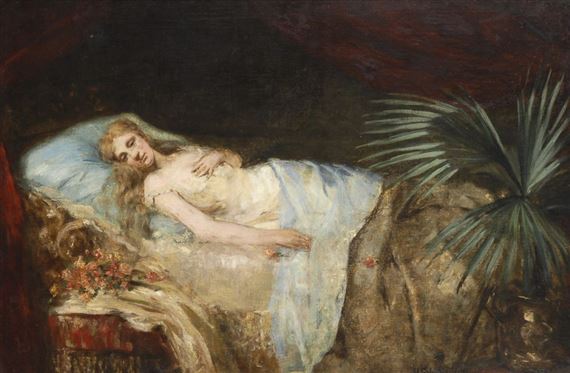
- Dame mit Rosenkorb, 1895[20] (in German)
See also
[edit]
Notes
[edit]
- ^ “Painter. Portraits, local figures, genre scenes.”[4]
- ^ “From June 19 to July 9, 1884.”[9]
- ^ “There are various accounts of the production of the Schmiechen portraits, yet all agree that the works are the result of inspiration.”[12]
- ^ “Hermann Schmiechen… agreed to take part in a ‘psychical experiment’ to see if images could be transferred to his mind from those who had seen the Masters.”[13]
- ^ Ident.Nr. A II 450. “Das undatierte, höchstwahrscheinlich private Bildnis einer jungen Frau, rückseitig ‘Irmgard’ beschriftet, dürfte noch aus der Düsseldorfer Zeit stammen.”[11]
- ^ Royal Collection, Cat. No. 624.[18]
- ^ Royal Collection, Cat. No. 625.[18]
- ^ Royal Collection, Cat. No. 626.[19]
- ^ Royal Collection, Cat. No. 627.[19]
References
[edit]
- ^ Jump up to:a b c Genealogie.
- ^ Neumarkt 1994, p. 176.
- ^ Introvigne 2015, pp. 18, 34.
- ^ Art Online.
- ^ Introvigne 2015, p. 18.
- ^ Neumarkt 1994, p. 176; Introvigne 2017, p. 212.
- ^ Selke 2003, p. 16.
- ^ Jump up to:a b Zeller.
- ^ Hao Chin.
- ^ French 2000, pp. 622–3.
- ^ Jump up to:a b Freyberger.
- ^ French 2000, p. 622.
- ^ Sasson 2012.
- ^ Solovyoff 1895, p. 78.
- ^ Introvigne 2015, p. 33.
- ^ French 2000, p. 609.
- ^ Introvigne 2015, p. 18; Introvigne 2017, p. 212.
- ^ Jump up to:a b Millar 1992, p. xxi.
- ^ Jump up to:a b Millar 1992, p. 628.
- ^ Introvigne 2015, p. 30.
Sources
[edit]
- Hermann Schmiechen. Oxford University Press. 31 October 2011. doi:10.1093/benz/9780199773787.article.B00164079. ISBN 978-0-19-977378-7. Retrieved 2019-01-16.
{{cite book}}:|website=ignored (help) - Schlesische Heimat: Stadt und Kreis Neumarkt (in German) (5th ed.). Der Verein. 1994. Retrieved 2019-01-16.
- “Hermann Schmiechen”. Genealogie von Heidermanns (in German). 2016. Retrieved 2019-01-16.
- “Malkasten archiv”. Künstlerverein Malkasten (in German). 2016. Archived from the original on 2018-07-12. Retrieved 2019-01-16.
- French, B. J. (2000). The Theosophical Masters: An Investigation into the Conceptual Domains of H. P. Blavatsky and C. W. Leadbeater (PDF) (PhD thesis). Sydney: University of Sydney. hdl:2123/7147. Retrieved 2019-01-16.
- Freyberger R. “Bildnis einer Dame”. Nationalgalerie (in German). Berlin: Staatliche Museen zu Berlin. Retrieved 2019-01-16.
- Hao Chin V. (8 May 2012). “Schmiechen, Hermann”. Theosopedia. Manila: Theosophical Publishing House. Retrieved 2019-01-16.
- Introvigne, M. (2015). Painting the Masters: The Mystery of Hermann Schmiechen (PDF). Torino: UPS. Retrieved 2019-01-16.
- ———— (2017). “Painting the Masters in Britain: From Schmiechen to Scott”. In Ferguson, C.; Radford, A. (eds.). The Occult Imagination in Britain: 1875–1947. Among the Victorians and Modernists. London: Routledge. pp. 206–26. ISBN 9781351168304. Retrieved 2019-01-16.
- Millar, O. (1992). The Victorian Pictures in the Collection of Her Majesty the Queen. Cambridge University Press. ISBN 9780521265225. Retrieved 2019-01-16.
- Sasson, D. (2012). “Koot Hoomi’s portrait”. In Albanese, C. L.; Stein, S. J. (eds.). Yearning for the New Age: Laura Holloway-Langford and Late Victorian Spirituality. Religion in North America. Bloomington: Indiana University Press. pp. 142–4. ISBN 9780253001771. Retrieved 2019-01-16.
- Selke, R. (2003). “Erfolg und Ruhm am Hof einer Königin”. In Bosbach, Franz (ed.). Ton Und Licht (PDF) (in German). Coburg. pp. 15–8. Archived from the original (PDF) on 2016-05-03. Retrieved 2019-01-16.
- Solovyoff, V. S. (1895). A Modern Priestess of Isis (PDF). Translated by Leaf, Walter (Abridged ed.). London: Longmans, Green, and Co. Retrieved 2019-01-16.
- Zeller M. (2014). “Turtelndes Liebespaar am Fenster”. Katalog (in German). Lindau: Auktionshaus Michael Zeller. Retrieved 2019-01-16
Wikimedia Commons has media related to Hermann Schmiechen.
 Theosophy & ARTS


