
English version below
Introduzione
L’architettura teosofica si riferisce alle opere architettoniche legate alla Società Teosofica o ispirate alla sua filosofia esoterica, sviluppata alla fine dell’Ottocento da Helena Blavatsky e altri. Questo stile non costituisce un movimento architettonico unico con regole formali rigide, ma un insieme eterogeneo di edifici e comunità plasmati da simbolismi esoterici, geometrie sacre e ideali spirituali condivisi. Tra fine Ottocento e primo Novecento, in un clima di rinnovato interesse per l’occulto e il misticismo, diversi architetti e committenti aderenti alla teosofia tentarono di tradurre “la Teosofia in pietra”, creando spazi che fossero al contempo funzionali e simbolicamente significativi. Questo documento offre una panoramica completa di tali monumenti e opere nel mondo – dagli edifici storici delle prime comunità teosofiche alle architetture contemporanee ispirate a principi esoterici – con esempi in Europa, America, Asia e Oceania. Verranno descritti i principali edifici e comunità spirituali, i progettisti più influenti (come Rudolf Steiner, Karel de Bazel, Claude Bragdon) e gli elementi distintivi dell’architettura teosofica, nonché le influenze esercitate su movimenti affini come l’antroposofia e l’architettura spirituale del primo Novecento.
Contesto e origini: Teosofia e architettura
La Società Teosofica, fondata nel 1875, mirava a promuovere una fratellanza universale e a studiare comparativamente religione, filosofia e scienza. Le idee teosofiche – che combinano concetti dell’esoterismo occidentale e delle religioni orientali – esercitarono un fascino particolare su alcuni circoli artistici e architettonici tra Ottocento e Novecento. Storici come Susan R. Henderson notano che correnti occultiste e mistiche permeavano la cultura modernista: movimenti dell’avanguardia come l’Espressionismo, il Suprematismo di Malevič, De Stijl e perfino teorici del Bauhaus mostrarono interesse verso schemi geometrici “sacri” e simboli esoterici, nel tentativo di trascendere il puro funzionalismo. In Olanda, ad esempio, l’Art Nouveau locale (Nieuwe Kunst) fu alimentata dal movimento teosofico emergente.
In architettura, la teosofia offriva un linguaggio di forme archetipiche e proporzioni cosmiche con cui alcuni progettisti cercarono di investire gli edifici di significati spirituali. Questa tendenza si inserisce nel filone più ampio dell’“occultismo e modernità” analizzato da vari studiosi, dove la geometria mistica fu impiegata per conferire all’architettura un’aura trascendente. La teosofia prometteva “un’alternativa alla modernità vissuta”, opponendosi alla mentalità positivista dominante e proponendo uno sguardo rivolto al trascendente. Per gli architetti teosofi – spesso anche aderenti alla massoneria o ad altre società iniziatiche – progettare edifici significava dunque creare templi laici per l’elevazione spirituale dell’umanità, integrando simboli e proporzioni che riecheggiassero leggi occulte e verità universali.
Comunità teosofiche e loro architetture distintive
Nel corso del primo Novecento sorsero diverse comunità basate su principi teosofici, dove l’architettura giocava un ruolo cruciale nel dare forma concreta agli ideali spirituali. Questi insediamenti intendevano essere modelli di vita comunitaria ispirata alla fratellanza universale e laboratori per sperimentare un’estetica edificante, ricca di riferimenti simbolici.
- Adyar, India (dal 1882) – La tenuta di Adyar a Chennai divenne la sede internazionale della Società Teosofica quando, nel 1882, Blavatsky e Henry Olcott vi trasferirono il quartier generale da New York. Sotto la presidenza di Annie Besant (1907-1933), il campus si espanse fino a oltre 100 ettari, con la donazione di molti edifici e giardini da parte di membri mecenati. Adyar fu concepita come una cittadella spirituale e pluralista: negli anni ’20 e ’30 vi sorsero luoghi di culto per tutte le grandi religioni, dal tempio indù (Bharata Samaj Temple, inaugurato 1925) al tempio buddhista, dalla chiesa della Liberal Catholic Church a una moschea, fino a un piccolo santuario sikh e perfino un tempio massonico. Questa molteplicità di edifici sacri – costruiti per essere “casa spirituale” di ogni credo – riflette il motto teosofico “Non vi è religione superiore alla Verità” e l’ecumenismo insito nel movimento. Architettonicamente, Adyar presenta un mix di stili coloniali tardo-vittoriani (nelle residenze storiche come la Blavatsky Bungalow) e strutture semplici immerse in lussureggianti giardini tropicali. Elementi teosofici compaiono soprattutto nell’iconografia: ad esempio, l’emblema della Società Teosofica (con i simboli di Om, la croce ansata, il serpente Ouroboros e la stella di Davide intrecciata al \swastika/) campeggia su stemmi e portali. Adyar rimane tutt’oggi un luogo di pellegrinaggio teosofico, con biblioteca e sale per convegni, dove l’ambiente naturale e architettonico è concepito per favorire lo studio e la meditazione.
- Point Loma (Lomaland), California, USA (1900-1942) – Fondata nel 1900 a San Diego da Katherine Tingley, leader della Società Teosofica Americana (fazione di William Judge), Lomaland fu una delle più celebri comunità teosofiche utopiche. Soprannominata la “White City” di Point Loma, aveva l’ambizione di incarnare in Occidente gli ideali spirituali orientali: simbolicamente, Tingley scelse l’estrema punta occidentale del continente americano ma “orientata verso l’India, centro spirituale delle credenze teosofiche”. Il campus sorse spogliando un arido promontorio e trasformandolo in un paradiso di giardini, orti e architetture eclettiche. Edifici principali erano l’Academy Building (sede della Raja Yoga Academy) e l’adiacente Tempio della Pace, completati nel 1900 e caratterizzati da grandi cupole di vetro color ametista visibili fino al largo della costa. Le forme riprendevano motivi classici (archi ribassati, colonnati) reinterpretati in chiave fantasiosa: l’architettura di Lomaland viene descritta come un “vernacolo teosofico” che includeva archi piatti e riferimenti stravaganti all’antichità. Le cupole, illuminate di notte, davano all’insediamento un aspetto fiabesco, mentre elementi simbolici abbondavano: ad esempio, il portale del Tempio della Pace era affiancato da due imponenti porte intagliate con allegorie dei principi teosofici di illuminazione spirituale e potenziale umano (le porte, opera dell’artista simbolista Reginald Machell, sono conservate presso la società storica di San Diego).
L’Academy Building e il Tempio della Pace a Lomaland (Point Loma, San Diego) in una foto d’epoca colorizzata, ca. 1915. Le cupole in vetro di colore acquamarina e ametista dominavano il complesso, concepito come centro educativo e spirituale teosofico. L’Academy Building e il Tempio della Pace a Lomaland (Point Loma, San Diego) in una foto d’epoca colorizzata, ca. 1915. Le cupole in vetro di colore acquamarina e ametista dominavano il complesso, concepito come centro educativo e spirituale teosofico.
Oltre ai due edifici principali, Lomaland ospitava teatri all’aperto (il primo teatro greco d’America, inaugurato nel 1901), biblioteche, laboratori artigianali, dormitori (le “Lotus Houses” per gli studenti) e persino industrie domestiche (tipografie, forni, laboratori tessili). Molte costruzioni mostravano un’ibridazione stilistica: la residenza di Albert Spalding (magnate dello sport che finanziò Tingley) combinava elementi del legno vittoriano con colonne ispirate al papiro egizio e archi ribassati moreschi. Questa contaminazione di stili occidentali e orientali incarnava la fusione di “amore per l’antico e spiritualità indiana” perseguita dalla comunità. Lomaland prosperò come vivace centro culturale (ospitando concerti, opere teatrali, conferenze) e sperimentò una forma avanzata di educazione integrale (la Raja Yoga School univa istruzione intellettuale, arte, morale e spirituale). La comunità declinò dopo la morte di Tingley nel 1929 e fu venduta nel 1942, ma il suo lasciato architettonico permane: diversi edifici, tra cui le cupole (restaurate negli anni ’80), furono inglobati nell’odierna Point Loma Nazarene University, mentre il quartiere circostante è ancor oggi chiamato “Wooded Area” per gli alberi piantati dai teosofi en.wikipedia.org.
- Krotona, Hollywood e Ojai, California (1912-…) – Un’altra comunità teosofica di rilievo negli Stati Uniti fu Krotona, fondata nel 1912 a Hollywood (Los Angeles) come sede della Società Teosofica guidata da Annie Besant dopo la morte di Tingley. Chiamata come l’antica Crotona pitagorica, divenne un centro per lo studio esoterico e la preparazione del presunto “Istruttore del Mondo” Jiddu Krishnamurti. Architettonicamente, Krotona presentava influenze moresche e mediterranee: tra le strutture vi erano un arco monumentale d’ingresso ornato di simboli, un centro amministrativo a corte e un piccolo anfiteatro. La scelta stilistica rifletteva la passione teosofica per l’Oriente: cupolette, cortili e giardini ricordavano più un ashram o un monastero spagnolo che non gli edifici americani coevi. Nel 1926 la comunità si trasferì a Ojai, località più tranquilla a nord di Los Angeles, dove ancora oggi esiste il Krotona Institute of Theosophy. A Ojai, immerso tra le colline, Krotona mantiene edifici in stile spagnolo-coloniale semplificato, sedi di biblioteche, sale di meditazione e alloggi per studenti di teosofia. Pur meno celebre di Lomaland, Krotona contribuì a diffondere un’estetica orientaleggiante nell’architettura californiana dell’epoca e rimane un attivo centro di formazione teosofica.
- Halcyon, California, USA (dal 1903) – Fondato nel 1903 da alcuni teosofi dissidenti (William Dower e Francia LaDue) come sede del gruppo denominato Temple of the People, Halcyon è un piccolo villaggio spirituale nei pressi di San Luis Obispo (California). Il suo cuore è il Blue Star Memorial Temple, costruito nel 1923-24: un edificio bianco circolare, con colonnato perimetrale e vetrate azzurre, che rappresenta uno degli esempi più interessanti di architettura teosofica in Nord America.
Il Blue Star Memorial Temple (Halcyon, California), costruito nel 1923 su progetto di Theodore Eisen. L’edificio, a pianta quasi circolare con un colonnato dorico semplificato, incorpora simboli teosofici e proporzioni basate sul numero 7templeofthepeople.org. Riconosciuto monumento storico, è tuttora utilizzato per funzioni spirituali dalla comunità.
La forma insolita del Tempio – una sorta di rotonda classicheggiante sormontata da una cupola piatta – fu concepita dal dott. Dower seguendo “linee di simbolismo matematico e geometrico”templeofthepeople.org. In particolare, ricorre ovunque il numero 7, considerato sacro: il peristilio esterno è scandito in sette settori, così come le finestre colorate presentano stelle a sette punte, e l’intero edificio vuole simboleggiare i sette piani di esistenza cari alla cosmologia teosofica (dalla materia allo spirito). Secondo gli statuti del Tempio, l’edificio stesso rappresenta “il Cuore della Coscienza divina” e incarna il motto “I dogmi scompaiono, i cuori rimangono”templeofthepeople.org. Halcyon, sebbene minuscola rispetto a Lomaland, è significativa perché testimonia la continuità del sogno teosofico utopico fino agli anni ’20: un luogo dove architettura, urbanistica e natura fossero armonizzati per facilitare la vita comunitaria spirituale. Oggi Halcyon è un distretto storico registrato, e il Blue Star Memorial Temple – con le sue candide colonne e le vetrate turchesi – appare come un tempietto neoclassico straniato nel paesaggio rurale californiano, carico di fascino esoterico.
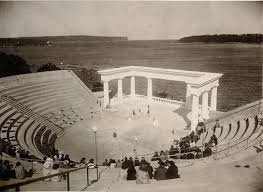
- Altre comunità e sedi degne di nota – In Europa non sorsero “colonie teosofiche” paragonabili a Lomaland, tuttavia esistettero centri di rilievo: ad esempio, a Huizen nei Paesi Bassi vi fu dal 1898 un centro teosofico rurale; a Sydney, Australia, la Loggia Blavatsky della Società Teosofica realizzò negli anni ’20 il suggestivo Star Amphitheatre a Balmoral Beach – un enorme anfiteatro vista oceano costruito per ospitare l’attesa venuta del nuovo Messia (Krishnamurti)abc.net.au.
- L’Anfiteatro delle Stelle, inaugurato nel 1924, poteva accogliere 2.000 persone sedute e si ispirava a modelli classici; tuttavia, dopo la “rinuncia” di Krishnamurti al ruolo messianico e il calo di entusiasmo, venne demolito nel 1951. In Nuova Zelanda, la Società Teosofica fu abbastanza attiva da erigere proprie sedi: ad esempio il Theosophical Hall di Wellington (1918) e quello di Auckland (1908) – semplici edifici funzionali ma arricchiti da biblioteche e sale di lettura – oppure la Theosophical Society Lodge di Reykjavík in Islanda (costruita 1913), segno dell’ampia diffusione geografica del movimentoen.wikipedia.org. Questi edifici, spesso modesti, riflettevano lo scopo pratico di ospitare conferenze, corsi e riunioni, ma nei dettagli decorativi potevano includere simboli come la stella a sei punte intrecciata o il loto, e nelle proporzioni cercavano un’armonia che rispecchiasse i principi teosofici di pace e fratellanza.
Di seguito, una tabella riepilogativa delle principali comunità e sedi teosofiche citate, con luogo, periodo di attività e note architettoniche distintive:
| Comunità/Sede | Luogo | Periodo | Caratteristiche architettoniche e simboliche |
|---|---|---|---|
| Quartier Generale Adyar | Chennai, India | dal 1882 (attivo) | Campus eclettico (stile coloniale tardo-vittoriano); templi multireligiosi sul terreno; parco sacro. |
| Lomaland (Point Loma) | San Diego, California (USA) | 1900–1942 | Cupole di vetro colorato (amethyst dome) su edifici principali; archi piatti e motivi classici rivisitati; porte simboliche intagliate. |
| Krotona | Hollywood/Ojai, California | 1912–oggi | Stile ispirato all’architettura moresca e missionaria spagnola; anfiteatro e giardini per meditazione; integrazione col paesaggio collinare. |
| Halcyon (Temple of People) | Halcyon, California (USA) | 1903–oggi | Tempio Blue Star (1923) a pianta circolare con colonnato; progettazione basata su numero 7 e geometrie sacretempleofthepeople.org; colonne bianche e vetrate azzurre. |
| Star Amphitheatre | Sydney, Australia | 1923–1951 | Anfiteatro all’aperto fronte mare, in cemento e pietra, ispirato a modelli classici; destinato a eventi spirituali (demolito). |
| Logge Teosofiche varie | (es. Reykjavík, Palmerston N.) | ca. 1890–oggi | Edifici urbani sobri con sale conferenze e biblioteche; simboli teosofici negli interni; luoghi d’incontro per membri locali. |
Architetti teosofi e opere architettoniche ispirate alla teosofia
Accanto alle comunità, un capitolo importante è rappresentato dagli architetti e artisti influenzati dalla teosofia, che inserirono elementi esoterici nei loro progetti. Pur non costituendo una “scuola” unitaria, questi progettisti condivisero l’aspirazione a un’architettura dal significato spirituale, spesso attraverso l’uso di proporzioni geometriche simboliche, ornamenti ricchi di allusioni e una fusione di stili orientali e occidentali. Ecco alcuni dei principali:
- Karel Petrus Cornelis de Bazel (1869–1923) – Architetto olandese, fu uno dei massimi esponenti del teosofismo in architettura in Europa. De Bazel aderì alla Società Teosofica nel 1894, lasciando lo studio dell’architetto cattolico P.J.H. Cuypers proprio a causa di questa nuova fede spirituale incompatibile col suo datore di lavoro. Con l’amico J.L.M. Lauweriks fondò ad Amsterdam la loggia teosofica Vahânaloge, dove teneva corsi di architettura collegando matematica, natura e cosmo. La sua opera più celebre è il palazzo De Bazel ad Amsterdam (1919-1926), originariamente sede della Banca Handelsmaatschappij e oggi archivio comunale. Questo massiccio edificio in mattoni e granito – considerato un esempio di brick expressionism olandese – rivela nell’ornamentazione interna un elaborato sistema di motivi geometrici e proporzioni armoniche ispirate a concezioni esoteriche. De Bazel, convinto massone oltre che teosofo, credeva nell’uso di rapporti numerici “sacri” (come quadrati e spirali) per conferire ordine e bellezza trascendente alle forme architettoniche. Nei disegni di arredi e vetrate impiegò spesso figure come la spirale, l’esagono, la croce ansata, e studiò templi orientali (come Borobudur a Java) cercando paralleli con diagrammi meditativi. Oltre al palazzo De Bazel – che è stato dichiarato monumento nazionale nei Paesi Bassi – realizzò ville, sinagoghe, mobili e grafiche, sempre con l’idea di un’arte totale (Gesamtkunstwerk) intrisa di spiritualità. Il suo allievo spirituale Lauweriks continuò su questa scia, sviluppando moduli geometrici proporzionali utilizzati persino dal celebre architetto tedesco Peter Behrens nei suoi progetti.
- Johannes Lauweriks (1864–1932) – Collaboratore di de Bazel, Lauweriks è noto per aver elaborato un sistema di proporzioni geometriche derivato da cerchio e quadrato, che poteva generare planimetrie ed elementi decorativi in infinite varianti armoniche. Influenzato dalla teosofia, Lauweriks riteneva che dietro le forme naturali vi fosse un ordine numerico universale. Applicò questi principi progettando edifici e arredi; il suo metodo fu insegnato anche a Düsseldorf e influenzò la nascita del movimento De Stijl (Piet Mondrian, prima di approdare all’astrattismo, fu membro della Società Teosofica e ricercò a lungo l’armonia cosmica nelle sue composizioni). Berlage, altro architetto olandese di spicco, pur non essendo teosofo, fu amico di Lauweriks e condivise l’interesse per la geometria come “ponte” tra funzione e simbolo. Questo mostra come la teosofia agì da catalizzatore di tendenze: non solo edifici direttamente commissionati dalla Società Teosofica, ma anche la tensione verso una “architettura trascendente” in alcuni maestri del Movimento Moderno.
- Claude Fayette Bragdon (1866–1946) – Architetto, illustratore e scrittore americano, attivo a Rochester (NY), fu membro della Società Teosofica e teorico di una “architettura del quarto piano” (riferita alla quarta dimensione). Bragdon concepiva l’architettura come “ritmo nello spazio” e cercò di creare un linguaggio ornamentale universale basato su forme geometriche fondamentali. Nei suoi libri – come “The Beautiful Necessity” (1910) e “A Primer of Higher Space” – spiegò la sua visione teosofica dell’architettura, auspicando un ritorno al simbolismo e all’uso di proporzioni armoniche pitagoriche. La sua invenzione più originale fu il metodo del “projective ornament”, in cui traeva motivi bidimensionali dalla proiezione di solidi geometrici regolari e ipersolidi (figure astratte nello spazio quadridimensionale). Curvi e colorati, tali motivi decorativi – arabeschi e cristalli – potevano poi essere applicati a superfici architettoniche, vetrate, tessuti, ecc., conferendo agli edifici un’aura di profondità spaziale e vitalità organica. Bragdon collaborò alla progettazione di edifici come l’arco di ingresso dell’Esposizione Panamericana (Buffalo, 1901) e il Palazzo di Giustizia di Rochester, e pubblicò progetti visionari come una “città ideale” modulare. Il collega James Cousins lo definì “l’architetto per cui l’Architettura è Teosofia in pietra”, riconoscendo come Bragdon avesse tradotto gli ideali teosofici di armonia, fratellanza e bellezza interiore nel lessico dell’architettura modernista. Negli anni ’20 si trasferì a New York dedicandosi a spettacoli teatrali multimediali: i suoi “Festival of Song and Light” prevedevano che il pubblico cantasse mentre luci colorate proiettavano forme geometriche sullo sfondo, creando un effetto di “vetrata vivente” – anche questa un’espressione dell’aspirazione a unire comunità, arte e spirito.
- Rudolf Steiner (1861–1925) – Filosofo e fondatore dell’antroposofia, Steiner nacque come figura di rilievo nella teosofia (fu Segretario Generale della sezione tedesca) prima di separarsene nel 1913 per divergenze dottrinali. Pur non essendo un architetto di formazione, progettò uno degli edifici più straordinari del XX secolo: il Goetheanum di Dornach (Svizzera), sede del movimento antroposofico. Il primo Goetheanum (1913-1922) era una costruzione in legno e cemento armato, con due grandi cupole intersecanti di diversa grandezza. L’idea era di creare uno spazio che esprimesse la metamorfosi e la dualità spirito-materia: le due cupole sovrapposte raffiguravano, secondo Steiner, l’unione tra mondo spirituale e mondo fisico. Le forme erano completamente organiche: niente angoli retti, ma superfici curvilinee intagliate come in una scultura continua, colonne con capitelli unici ispirati a forme vegetali in crescita, pareti dipinte con tonalità cangianti. L’edificio, utilizzato come sala per conferenze, rappresentazioni di euritmia (danza sacra antroposofica) e concerti, ricordava un tempio ovoidale dall’aspetto onirico. Purtroppo il primo Goetheanum venne distrutto da un incendio doloso nel 1922. Steiner allora progettò il secondo Goetheanum (1924-1928), realizzato interamente in cemento armato a vista: un’imponente massa scultorea poligonale che siede su una collina nei pressi di Basilea.
Veduta frontale del Secondo Goetheanum (1928) a Dornach, progettato da Rudolf Steiner. L’architettura organica in calcestruzzo sagomato e asimmetrico riflette gli ideali antroposofici, fungendo da “tempio dell’arte totale” dove ogni forma è significante spirituale.
L’architettura del Goetheanum – con le sue masse fluide in cemento grezzo – è stata definita precorritrice del brutalismo e unica nel suo genere. Il critico Edwin Heathcote la descrive come “una costruzione monumentale scolpita, stranamente in anticipo sui tempi e di difficile categorizzazione”. In effetti il Goetheanum rimane un caso a sé: Steiner vi riversò tutta la sua visione antroposofica, dall’uso di forme biomorfe (per evocare un’architettura viva, in evoluzione continua) all’assenza di ornamenti storicisti (l’edificio stesso è “ornamento” plasmato), fino alla concezione degli spazi interni come luoghi di elevazione comunitaria e artistica. Attorno al Goetheanum sorse una piccola comunità di seguaci che costruirono case e laboratori seguendo il medesimo stile organico, dando vita a un singolare paesaggio architettonico. Pur non rientrando strettamente nella “teosofia” (dopo il 1913 Steiner se ne distaccò per fondare l’antroposofia), l’opera architettonica di Steiner è spesso citata come l’eredità parallela e più radicale della teosofia nell’architettura: entrambi i movimenti volevano unire arte, spiritualità e vita pratica in un tutt’uno armonico, e con Steiner quest’idea toccò il suo apice espressivo.
- Altri architetti influenzati – Oltre ai suddetti, vale la pena menzionare figure come Henry Van de Velde (che pur non teosofo era amico di Steiner e condivise alcune istanze simboliste), Frank Lloyd Wright, che ebbe contatti indiretti con idee teosofiche tramite la Prairie School di Chicago (Claude Bragdon è considerato parte di questa scuola e Wright stesso integrò spesso simbolismi geometrici nei suoi fregi, ispirati a concetti spirituali universali). In Australia, William Lethaby studiò l’architettura sacra e l’alchimia, producendo confronti tra cattedrali gotiche e forme “magiche”. In India, l’architetto britannico Henry A. Nicoll progettò nel 1933 il santuario del Tempio di Servizio Universale a Adyar (un padiglione circolare per cerimonie universali voluto da Annie Besant). Charles Leadbeater, il famoso teosofo, non era architetto ma guidò la costruzione di chiese della Liberal Catholic Church con iconografia teosofica (ad esempio la St. Michael’s Church ad Adyar nel 1925, dove inserì vetrate con angeli ispirati alle sue visioni chiaroveggenti). Questi esempi mostrano come la teosofia permeò il mondo architettonico in vari modi: dagli edifici commissionati dal movimento stesso, alle influenze sottili su architetti che ricercavano un significato più alto e “spirituale” nelle forme.
Per chiarire ulteriormente il contributo di alcuni dei protagonisti sopra citati, segue una tabella riassuntiva di alcuni architetti e designer teosofi o affini, con le loro opere e tratti distintivi:
| Architetto/Designer | Paese/Periodo | Opere legate alla teosofia | Elementi distintivi |
|---|---|---|---|
| Karel P. C. de Bazel | Paesi Bassi (1900 ca.) | Palazzo De Bazel ad Amsterdam (1919-26); arredi e vetrate per logge teosofiche. | Simbolismo geometrico matematico (spirali, reticoli); influenze orientali (ispirazione al tempio di Borobudur); teosofo e massone convintotheosophyforward.com. |
| J. L. M. Lauweriks | Paesi Bassi/Germania (1900) | Piani urbanistici e arredi basati su griglie proporzionali; insegnamento alla Scuola di Amsterdam. | Teoria dei moduli geometrici universali; cercò leggi cosmiche nelle proporzioni architettoniche. |
| Claude Bragdon | USA (1900-1920) | Edifici a Rochester (es. facciata New York Central Station); libri The Beautiful Necessity, Four-Dimensional Vistas. | Ornamenti da proiezioni di solidi 4D; fusione di motivi orientali (arabeschi) e occidentali (forme cristalline); concezione dell’architettura come arte sociale per l’armonia comunitaria. |
| Rudolf Steiner | Austria/Svizzera (1913-25) | Primo e Secondo Goetheanum a Dornach; case dei membri antroposofi nell’area di Dornach. | Architettura organica espressiva (forme plastiche non geometriche); integrazione di scultura, pittura, vetrate (arte totale); ispirazione spirituale antroposofica (oltre la teosofia “classica”). |
| Annie Besant & C. W. Leadbeater (committenti) | India/Australia (1900-1930) | Star Amphitheatre (Sydney, 1924)abc.net.au; Tempio Unversale di Adyar (1933); chiese Liberale-Cattoliche (es. Sydney, 1917). | Promozione di edifici per rituali ecumenici; interpretazione libera di stili storici per fini simbolici; coinvolgimento di architetti locali secondo indicazioni teosofiche. |
Temi e elementi distintivi dell’architettura teosofica
Dall’analisi di comunità e architetti emergono alcuni temi ricorrenti e tratti caratteristici nell’architettura ispirata alla teosofia:
- Simbolismo esoterico: Gli edifici teosofici fungono spesso da “libri di pietra” che comunicano idee spirituali attraverso simboli. Ad Adyar troviamo una compenetrazione di simboli religiosi di varie tradizioni (il loto buddhista, l’Om indù, la croce egizia ankh, ecc.), a significare l’unità trascendente delle fedi. A Lomaland, le porte scolpite del Tempio della Pace rappresentavano concetti di illuminazione e progresso dell’anima. A Halcyon, l’intera struttura del Blue Star Temple è concepita come simbolo – le 7 aperture, 7 colori, 7 note incarnano la chiave settenaria della cosmologia occultatempleofthepeople.org. Questo uso didascalico del simbolo differenzia l’architettura teosofica dal mero storicismo decorativo: qui l’ornamento ha uno scopo filosofico, cerca di elevare la coscienza di chi fruisce dello spazio. Claude Bragdon sottolineava l’importanza di “costruire altari al Bello” per riconnettere l’individuo con l’armonia universale. Ne è esempio il suo progetto per la sede teosofica di Wheaton (Illinois), dove immaginò un edificio coronato da una volta con motivi geometrici integrati a vetrate colorate, come un mandala tridimensionale (il progetto poi fu realizzato da Irving Pond seguendo questi concettitheosophical.org).
- Geometrie sacre e proporzioni armoniche: Quasi tutti i progettisti teosofi insistevano sull’uso di forme geometriche pure – cerchi, quadrati, triangoli, spirali – dotate secondo loro di poteri armonizzanti. De Bazel e Lauweriks svilupparono interi moduli proporzionali derivati da figure semplici (il quadrato dentro il cerchio, la stella a sei punte, ecc.) per proporzionare planimetrie e facciateen.wikipedia.org. Bragdon traeva decorazioni dalla sezione aurea e dall’iperspazio. A Halcyon il numero sette determina geometrie e dimensioni. Steiner, pur rompendo con la geometria euclidea, seguì un’altra logica “sacra”: quella dei processi organici di crescita, dunque una sorta di geometria vivente. In generale, l’architettura teosofica rifiuta l’arbitrio compositivo: nulla è solo estetico, ogni misura vuole risuonare con un ordine cosmico – è un approccio quasi pitagorico. Nei primi decenni del Novecento, questo influsso teosofico contribuì alla tendenza di molti architetti moderni a cercare basi teoriche matematiche per il progetto (si pensi al Modulor di Le Corbusier negli anni ’40, anticipato però da queste sperimentazioni esoteriche).
- Forme organiche e natura: Alcuni architetti teosofi predilessero forme ispirate alla natura, considerate manifestazione del divino. Ciò è palese in Steiner, i cui capitelli sembrano fiori scolpiti e le cui finestre ricordano alveoli cellulari. Ma anche a Point Loma, Machell disegnò arredi interni influenzati dallo stile simbolista europeo con motivi vegetali stilizzati. Il rapporto con la natura era anche pratico: le comunità teosofiche puntavano all’autosufficienza agricola e a una vita semplice in ambienti salubri. I giardini avevano valenza spirituale (il boschetto Besant ad Adyar, i boschi piantati a Lomaland). L’architettura quindi si integrava col paesaggio e spesso lo migliorava: a Point Loma si piantarono migliaia di alberi trasformando una brulla collina in un parcoen.wikipedia.org. Anche nelle scelte materiche, si tendeva a impiegare materiali naturali o locali: legno (Goetheanum I), pietra e mattoni (De Bazel), intonaci e colori terrosi (Krotona, con le sue tinte adobe). Questo aspetto si collega all’ideale teosofico di non violenza e rispetto di tutti i regni della natura: costruire in armonia con l’ambiente, senza devastarlo.
- Eclettismo stilistico e riferimenti interculturali: L’architettura teosofica è fortemente sincretica, così come la teosofia unisce dottrine d’Oriente e Occidente. Ne risulta un eclettismo consapevole: a Lomaland coesistevano richiami all’architettura classica (teatro greco, colonnati) e all’Oriente indiano (cupole ricordanti lo stupa buddhista). A Halcyon, il tempio sembra un piccolo Pantheon neoclassico, ma la sua concezione numerologica è più vicina a un tempio massonico. Adyar costruì fianco a fianco una chiesa cristiana non denominazionale e una moschea – una vicinanza impensabile altrove. Questo pluralismo stilistico rifletteva la visione teosofica dell’unità sostanziale di tutte le tradizioni: ogni stile era valido se veicolava il messaggio spirituale. Tuttavia, non mancarono approcci originali: De Bazel adottò un art déco mistico, Bragdon uno stile Prairie astratto, Steiner creò ex novo un vocabolario formale. Ciò testimonia che l’architettura teosofica non è un “neo-stile” storico ma un orientamento, un modo di intendere l’architettura come ponte tra culture e epoche, tra visibile e invisibile.
- Funzione educativa e comunitaria: Quasi tutti gli edifici teosofici avevano scopi educativi, culturali o rituali – raramente puramente residenziali (salvo le case all’interno delle comunità). Erano scuole, biblioteche, teatri, templi, sedi di logge. Questo perché la missione teosofica era divulgare conoscenza e creare spazi di crescita interiore. Ad esempio, la Raja Yoga Academy di Lomaland ospitava corsi per bambini e adulti basati su un curriculum integrale; il teatro all’aperto serviva per drammi classici con valenza morale; le sale di Adyar accoglievano conferenze internazionali. Dal punto di vista architettonico, ciò significò spesso ambienti ampi, versatili e luminosi. Bragdon, nel progettare sale, enfatizzava la pianta aperta e l’uso della luce zenitale e dei colori per elevare lo spirito. A Wheaton (sede teosofica USA) si preferì la costruzione in mezzo alla natura, lontano dal caos cittadino, per favorire concentrazione e meditazione. Insomma, forma e funzione erano entrambe piegate al fine superiore dell’evoluzione spirituale degli utenti.
Influenze sulla cultura architettonica e movimenti affini
Le idee teosofiche in architettura ebbero un’influenza che travalicò i confini della Società Teosofica stessa, contribuendo ad alcuni orientamenti generali dell’architettura spirituale del primo Novecento:
- Antroposofia e bio-architettura: Come già evidenziato, l’antroposofia di Rudolf Steiner è l’erede diretta della teosofia in ambito architettonico. Molti architetti antroposofi successivi (es. Ita Wegman e gli architetti della seconda generazione antroposofica) costruirono scuole Waldorf, cliniche e banche seguendo i principi organici steineriani. Oggi esistono centinaia di edifici in stile antroposofico nel mondo (dalle scuole Steineriane con finestre asimmetriche e planimetrie flessuose, fino a complessi come il centro Camphill in Scozia). Questo movimento è figlio della visione teosofica che l’ambiente costruito possa influire sull’anima: colori tenui, forme morbide, materiali naturali sono utilizzati per creare ambienti a misura d’uomo e in risonanza con la natura. L’antroposofia è dunque un ramo autonomo, ma affonda le radici nelle stesse istanze: spiritualizzare l’architettura e rendere l’architettura veicolo di guarigione e crescita interiore.
- Movimento Arts & Crafts e Art Nouveau esoterica: In Inghilterra e altrove, la fine Ottocento vide un revival dell’occulto che toccò anche le arti applicate. Personalità come William Lethaby e Charles Voysey (sebbene non formalmente teosofi) esplorarono simboli alchemici e massonici nei loro scritti e talvolta nei decori. In Francia e Belgio, l’Art Nouveau ebbe una corrente esoterica: Fernand Khnopff e Victor Horta condivisero ambienti con teosofi e questo traspare in alcuni interni pieni di simboli. Ad esempio, Horta progettò per l’amico Maurice Maeterlinck (drammaturgo simbolista legato a idee teosofiche) il padiglione “Tempio delle Passioni Umane” a Bruxelles, con sculture enigmatiche. Nei Paesi Bassi, come citato, la Nieuwe Kunst fu in parte alimentata dal pensiero teosofico e architetti come Berlage incorporarono schemi geometrici quasi meditativi nelle decorazioni delle loro opere (la Borsa di Amsterdam di Berlage ha un mosaico pavimentale basato su suddivisioni rigorose, e l’architetto studiò i testi di Blavatsky e Leadbeater). Anche il movimento De Stijl – pur noto per il suo astrattismo funzionale – nacque in un contesto imbevuto di teosofia: Piet Mondrian e Theo Van Doesburg frequentarono logge teosofiche e cercarono di esprimere l’essenza spirituale attraverso l’astrazione di forme e colori puri.
- Espressionismo e utopie architettoniche: L’architettura espressionista tedesca post-bellica (1918-1925) vide la fioritura di fantasiose “cattedrali” e “città di vetro” spesso con sottotesti mistici. Bruno Taut nel suo scritto Die Stadtkrone (1919) immaginava una città ideale coronata da un palazzo di cristallo al centro – un’idea affine alla nozione teosofica di un tempio centrale per l’umanità. L’Alpine Architektur di Taut (disegni di architetture di vetro sulle Alpi) e gli schemi di Hermann Finsterlin presentano forme simili a quelle del Goetheanum, suggerendo che Steiner e teosofi fossero tra le fonti d’ispirazione. In parallelo, gruppi come i Rosacroce e la Massoneria commissionarono templi e sale in quel periodo: ad esempio, Le Corbusier progettò nel 1929 il Padiglione dell’Esprit Nouveau con l’idea che fosse un modulo abitativo universale e razionale – pur nella sua razionalità, egli era influenzato dal culto della geometria di tradizione massonica e dai rapporti armonici che trovavano echi nella teosofia. Quindi, sebbene i teosofi in quanto tali non costruirono moltissimo, il loro linguaggio di simboli e geometrie infuse di significato ebbe risonanza in vari filoni dell’architettura visionaria del Novecento.
Conclusione
In conclusione, i monumenti e le architetture teosofiche nel mondo costituiscono un patrimonio affascinante e poco noto, in cui l’anelito spirituale prende forma tangibile. Dal tropicale campus di Adyar alle candide cupole di Lomaland, dal tempio-calendario di Halcyon al mastodonte visionario del Goetheanum, questi edifici testimoniano il tentativo di riconciliare materia e spirito attraverso l’arte del costruire. Pur nella diversità di stili e contesti geografici, essi condividono l’idea che l’architettura possa elevare l’umanità, funzionando come un ponte tra il visibile e l’invisibile. La teosofia, come movimento spirituale, declinò in popolarità verso la metà del Novecento; eppure le sue impronte sopravvivono nell’ambito architettonico – sia concretamente, nei manufatti storici restaurati e tutelati (diversi edifici di Point Loma sono oggi monumenti storici, Halcyon è nel Registro Nazionale USAcommons.wikimedia.org, il Goetheanum è meta di studiosi di architettura) – sia idealmente, nell’eredità di una visione olistica dell’architettura. In tempi recenti, l’eco di quell’approccio si ritrova nell’architettura olistica e sostenibile, che riconsidera l’ambiente costruito come parte di un tutto vivente, e nella continua ricerca di significato simbolico in architettura sacra contemporanea (ad esempio nei templi della New Age o nei centri di meditazione). Studiare l’architettura teosofica significa riscoprire un capitolo in cui utopia sociale, misticismo e design si intrecciano strettamente – un capitolo che arricchisce la storia dell’architettura con un esempio di come le idee filosofico-spirituali possano plasmare concretamente lo spazio umano.
In definitiva, i teosofi ci hanno lasciato non solo edifici, ma un messaggio: che anche muri, colonne e cupole possono “parlare” all’anima, se progettati con intento elevato. L’architettura teosofica, nei suoi momenti migliori, è stata proprio questo – teosofia resa pietra, bellezza fatta preghiera muta, per ispirare generazioni future nella ricerca di una sintesi tra bellezza, verità e vita.
Fonti: Questa panoramica si basa su ricerche storiche e documentarie di varia natura: dagli atti della Società Teosofica e dalle voci enciclopediche su luoghi e persone chiave, a studi accademici sull’intersezione fra occultismo e modernismo. Sono state consultate fonti primarie come scritti di architetti (es. Bragdon) e resoconti d’epoca, nonché analisi contemporanee (Apollo Magazine, 2022) sulle opere di Steiner. Le immagini allegate provengono da archivi digitali e Wikimedia Commons, documentando visivamente alcuni esempi salienti. La tabella delle comunità e quella degli architetti sono compilazioni originali sulla base dei dati raccolti. Questa trattazione intende offrire un quadro esaustivo fino al 2025, integrando le informazioni più aggiornate disponibili.
__________________________________________________________________________________________________________
Theosophical Architecture: Historical and Contemporary Overview
Introduction
Theosophical architecture refers to the architectural works linked to the Theosophical Society or inspired by its esoteric philosophy, developed at the end of the 19th century by Helena Blavatsky and others. This style does not constitute a single architectural movement with rigid formal rules, but a heterogeneous collection of buildings and communities shaped by esoteric symbolism, sacred geometry and shared spiritual ideals. Between the late 19th and early 20th centuries, in a climate of renewed interest in the occult and mysticism, several architects and clients who were followers of Theosophy attempted to translate “Theosophy into stone”, creating spaces that were both functional and symbolically significant. This document offers a complete overview of these monuments and works around the world – from the historic buildings of the first theosophical communities to contemporary architecture inspired by esoteric principles – with examples in Europe, America, Asia and Oceania. The book will describe the main buildings and spiritual communities, the most influential designers (such as Rudolf Steiner, Karel de Bazel, Claude Bragdon) and the distinctive elements of theosophical architecture, as well as the influences on similar movements such as anthroposophy and spiritual architecture of the early 20th century.
Context and origins: Theosophy and architecture
The Theosophical Society, founded in 1875, aimed to promote universal brotherhood and to study religion, philosophy and science comparatively. Theosophical ideas – which combine concepts of Western esotericism and Eastern religions – exerted a particular fascination on some artistic and architectural circles between the 19th and 20th centuries. Historians such as Susan R. Henderson note that occultist and mystical currents permeated modernist culture: avant-garde movements such as Expressionism, Malevich’s Suprematism, De Stijl and even Bauhaus theorists showed an interest in “sacred” geometric patterns and esoteric symbols in an attempt to transcend pure functionalism. In Holland, for example, the local Art Nouveau (Nieuwe Kunst) was fueled by the emerging theosophical movement.
In architecture, theosophy offered a language of archetypal forms and cosmic proportions with which some designers tried to invest buildings with spiritual meanings. This trend is part of the broader trend of “occultism and modernity” analyzed by various scholars, where mystical geometry was used to give architecture a transcendent aura. Theosophy promised “an alternative to lived modernity”, opposing the dominant positivist mentality and proposing a look towards the transcendent. For theosophist architects – who often also belonged to freemasonry or other initiatory societies – designing buildings meant creating secular temples for the spiritual elevation of humanity, integrating symbols and proportions that echoed occult laws and universal truths.
Theosophical communities and their distinctive architecture
During the early 20th century, several communities based on theosophical principles were established, where architecture played a crucial role in giving concrete form to spiritual ideals. These settlements were intended to be models of community life inspired by universal brotherhood and laboratories for experimenting with an uplifting aesthetic, rich in symbolic references.
- Adyar, India (since 1882) – The Adyar estate in Chennai became the international headquarters of the Theosophical Society when, in 1882, Blavatsky and Henry Olcott moved the headquarters there from New York. Under the presidency of Annie Besant (1907-1933), the campus expanded to over 100 hectares, with the donation of many buildings and gardens by patron members. Adyar was conceived as a spiritual and pluralistic citadel: in the 1920s and 1930s, places of worship for all the major religions were built there, from a Hindu temple (Bharata Samaj Temple, inaugurated in 1925) to a Buddhist temple, from a church of the Liberal Catholic Church to a mosque, to a small Sikh shrine and even a Masonic temple. This variety of sacred buildings – built to be a “spiritual home” for every faith – reflects the theosophical motto “There is no religion higher than Truth” and the ecumenism inherent in the movement. Architecturally, Adyar presents a mix of late Victorian colonial styles (in historic residences such as the Blavatsky Bungalow) and simple structures immersed in lush tropical gardens. Theosophical elements appear mainly in the iconography: for example, the emblem of the Theosophical Society (with the symbols of the Om, the cross with the wings, the Ouroboros serpent and the Star of David intertwined with the \swastika/) stands out on coats of arms and portals. Adyar is still a place of theosophical pilgrimage, with a library and conference rooms, where the natural and architectural environment is designed to encourage study and meditation.
- Point Loma (Lomaland), California, USA (1900-1942) – Founded in 1900 in San Diego by Katherine Tingley, leader of the American Theosophical Society (a faction of William Judge), Lomaland was one of the most famous utopian theosophical communities. Nicknamed the “White City” of Point Loma, it had the ambition of embodying Eastern spiritual ideals in the West: symbolically, Tingley chose the extreme western tip of the American continent but “oriented towards India, the spiritual center of Theosophical beliefs”. The campus was created by clearing an arid promontory and transforming it into a paradise of gardens, vegetable plots and eclectic architecture. The main buildings were the Academy Building (home of the Raja Yoga Academy) and the adjacent Temple of Peace, completed in 1900 and characterized by large amethyst-colored glass domes visible from the coast. The forms were based on classical motifs (low arches, colonnades) reinterpreted in an imaginative way: the architecture of Lomaland is described as a “theosophical vernacular” that included flat arches and extravagant references to antiquity. The domes, illuminated at night, gave the settlement a fairytale appearance, while symbolic elements abounded: for example, the portal of the Temple of Peace was flanked by two imposing carved doors with allegories of the theosophical principles of spiritual enlightenment and human potential (the doors, by the symbolist artist Reginald Machell, are preserved at the historical society of San Diego).
The Academy Building and the Temple of Peace at Lomaland (Point Loma, San Diego) in a colorized period photo, ca. 1915. The aquamarine and amethyst glass domes dominated the complex, conceived as a Theosophical educational and spiritual center.
In addition to the two main buildings, Lomaland had open-air theaters (the first Greek theater in America, inaugurated in 1901), libraries, craft workshops, dormitories (the “Lotus Houses” for students) and even domestic industries (printing shops, bakeries, textile workshops). Many buildings showed a stylistic hybridization: the residence of Albert Spalding (sports magnate who financed Tingley) combined Victorian wooden elements with columns inspired by Egyptian papyrus and Moorish segmental arches. This contamination of Western and Eastern styles embodied the fusion of “love for the ancient and Indian spirituality” pursued by the community. Lomaland flourished as a lively cultural center (hosting concerts, plays, conferences) and experimented with an advanced form of integral education (the Raja Yoga School combined intellectual, artistic, moral and spiritual education). The community declined after Tingley’s death in 1929 and was sold in 1942, but its architectural legacy remains: several buildings, including the domes (restored in the 1980s), were incorporated into today’s Point Loma Nazarene University, while the surrounding neighborhood is still called the “Wooded Area” because of the trees planted by the Theosophists.en.wikipedia.org.
- Krotona, Hollywood and Ojai, California (1912-…) – Another important theosophical community in the United States was Krotona, founded in 1912 in Hollywood (Los Angeles) as the headquarters of the Theosophical Society led by Annie Besant after Tingley’s death. Named after the ancient Pythagorean Croton, it became a center for esoteric study and the preparation of the alleged “World Teacher” Jiddu Krishnamurti. Architecturally, Krotona showed Moorish and Mediterranean influences: the structures included a monumental entrance arch decorated with symbols, a courtyard administrative center and a small amphitheater. The stylistic choice reflected the theosophical passion for the Orient: domes, courtyards and gardens were more reminiscent of an ashram or a Spanish monastery than contemporary American buildings. In 1926 the community moved to Ojai, a quieter town north of Los Angeles, where the Krotona Institute of Theosophy still exists today. In Ojai, nestled in the hills, Krotona maintains simplified Spanish-colonial style buildings, libraries, meditation halls and lodgings for students of Theosophy. Although less famous than Lomaland, Krotona contributed to spreading an oriental-style aesthetic in Californian architecture of the time and remains an active center for Theosophical studies.
- Halcyon, California, USA (since 1903) – Founded in 1903 by a group of dissident theosophists (William Dower and Francia LaDue) as the headquarters of the group called Temple of the People, Halcyon is a small spiritual village near San Luis Obispo (California). Its centerpiece is the Blue Star Memorial Temple, built in 1923-24: a circular white building with a colonnade around the perimeter and blue glass windows, which is one of the most interesting examples of theosophical architecture in North America.
The Blue Star Memorial Temple (Halcyon, California), built in 1923 to a design by Theodore Eisen. The building, with an almost circular plan and a simplified Doric colonnade, incorporates Theosophical symbols and proportions based on the number 7templeofthepeople.org. Recognized as a historical monument, it is still used for spiritual functions by the community.
The unusual shape of the Temple – a sort of classical rotunda surmounted by a flat dome – was conceived by Dr. Dower following “lines of mathematical and geometric symbolism”templeofthepeople.org. In particular, the number 7, considered sacred, recurs everywhere: the external peristyle is divided into seven sectors, the colored windows have seven-pointed stars, and the entire building symbolizes the seven planes of existence dear to theosophical cosmology (from matter to spirit). According to the Temple’s statutes, the building itself represents “the Heart of Divine Consciousness” and embodies the motto “Dogmas disappear, hearts remain”templeofthepeople.org. Halcyon, although tiny compared to Lomaland, is significant because it testifies to the continuity of the utopian theosophical dream until the 1920s: a place where architecture, urban planning and nature were harmonized to facilitate spiritual community life. Today Halcyon is a registered historical district, and the Blue Star Memorial Temple – with its white columns and turquoise glass windows – looks like a neoclassical temple, alienated in the Californian rural landscape, full of esoteric charm.
- Other communities and locations worthy of note – In Europe there were no “theosophical colonies” comparable to Lomaland, however there were important centers: for example, in Huizen in the Netherlands there was a rural theosophical center from 1898; in Sydney, Australia, the Blavatsky Lodge of the Theosophical Society built the impressive Star Amphitheater in Balmoral Beach in the 1920s – a huge amphitheater overlooking the ocean built to host the awaited coming of the new Messiah (Krishnamurti)abc.net.au. The Star Amphitheater, inaugurated in 1924, could seat 2,000 people and was inspired by classical models; however, after Krishnamurti “renounced” his messianic role and enthusiasm waned, it was demolished in 1951. In New Zealand, the Theosophical Society was active enough to erect its own headquarters: for example Theosophical Hall in Wellington (1918) and in Auckland (1908) – simple functional buildings but enriched with libraries and reading rooms – or the Theosophical Society Lodge in Reykjavík, Iceland (built in 1913), a sign of the wide geographical spread of the movementen.wikipedia.org. These buildings, often modest, reflected the practical purpose of hosting conferences, courses and meetings, but in the decorative details they could include symbols such as the intertwined six-pointed star or the lotus, and in the proportions they sought a harmony that reflected the theosophical principles of peace and brotherhood.
Below is a summary table of the main theosophical communities and centers mentioned, with location, period of activity and distinctive architectural features:
Community/Center Location Period Architectural and symbolic features
Headquarters Adyar Chennai, India since 1882 (active) Eclectic campus (late Victorian colonial style); multi-religious temples on the grounds; sacred park.
Lomaland (Point Loma) San Diego, California (USA) 1900–1942 Domes of colored glass (amethyst dome) on main buildings; flat arches and revisited classical motifs; symbolic carved doors.
Krotona Hollywood/Ojai, California 1912–present Style inspired by Moorish architecture and Spanish missions; amphitheater and meditation gardens; integration with the hilly landscape.
Halcyon (Temple of People) Halcyon, California (USA) 1903–present Blue Star Temple (1923) with a circular plan and colonnade; design based on the number 7 and sacred geometries templeofthepeople.org; white columns and blue glass.
Star Amphitheater Sydney, Australia 1923–1951 Open-air amphitheater facing the sea, in concrete and stone, inspired by classical models; intended for spiritual events (demolished).
Various Theosophical Lodges (e.g. Reykjavík, Palmerston North) c. 1890–present Sober urban buildings with conference rooms and libraries; theosophical symbols in the interior; meeting places for local members.
Theosophical architects and theosophy-inspired architectural works
Alongside the communities, an important chapter is represented by the architects and artists influenced by Theosophy, who inserted esoteric elements into their projects. Although they did not constitute a unified “school”, these designers shared the aspiration for an architecture with spiritual significance, often through the use of symbolic geometric proportions, ornamentation rich in allusions and a fusion of Eastern and Western styles. Here are some of the main ones:
- Karel Petrus Cornelis de Bazel (1869–1923) – Dutch architect, he was one of the greatest exponents of theosophical architecture in Europe. De Bazel joined the Theosophical Society in 1894, leaving the studio of the Catholic architect P.J.H. Cuypers precisely because of this new spiritual faith that was incompatible with his employer. With his friend J.L.M. Lauweriks he founded the theosophical lodge Vahânaloge in Amsterdam, where he held courses in architecture linking mathematics, nature and the cosmos. His most famous work is the De Bazel building in Amsterdam (1919-1926), originally the headquarters of the Handelsmaatschappij Bank and now the municipal archive. This massive brick and granite building – considered an example of Dutch brick expressionism – reveals an elaborate system of geometric motifs and harmonious proportions inspired by esoteric concepts in its interior decoration. De Bazel, a convinced freemason as well as theosophist, believed in the use of “sacred” numerical ratios (such as squares and spirals) to confer order and transcendent beauty to architectural forms. In his designs for furnishings and stained glass windows he often used figures such as the spiral, the hexagon, the cross, and he studied oriental temples (such as Borobudur in Java) looking for parallels with meditative diagrams. In addition to the De Bazel building – which has been declared a national monument in the Netherlands – he also designed villas, synagogues, furniture and graphics, always with the idea of a total work of art (Gesamtkunstwerk) imbued with spirituality. His spiritual pupil Lauweriks continued along these lines, developing proportional geometric modules that were even used by the famous German architect Peter Behrens in his projects.
- Johannes Lauweriks (1864–1932) – A collaborator of de Bazel, Lauweriks is known for having developed a system of geometric proportions derived from the circle and square, which could generate floor plans and decorative elements in infinite harmonic variations. Influenced by theosophy, Lauweriks believed that behind natural forms there was a universal numerical order. He applied these principles when designing buildings and furnishings; his method was also taught in Düsseldorf and influenced the birth of the De Stijl movement (Piet Mondrian, before moving on to abstractionism, was a member of the Theosophical Society and long sought cosmic harmony in his compositions). Berlage, another prominent Dutch architect, was not a theosophist but was a friend of Lauweriks and shared his interest in geometry as a “bridge” between function and symbol. This shows how theosophy acted as a catalyst for trends: not only buildings directly commissioned by the Theosophical Society, but also the tendency towards a “transcendent architecture” in some masters of the Modern Movement.
- Claude Fayette Bragdon (1866–1946) – American architect, illustrator and writer, active in Rochester (NY), he was a member of the Theosophical Society and theorist of an “architecture of the fourth plane” (referring to the fourth dimension). Bragdon conceived of architecture as “rhythm in space” and tried to create a universal ornamental language based on fundamental geometric forms. In his books – such as “The Beautiful Necessity” (1910) and “A Primer of Higher Space” – he explained his theosophical vision of architecture, hoping for a return to symbolism and the use of harmonic Pythagorean proportions. His most original invention was the method of “projective ornament”, in which he drew two-dimensional motifs from the projection of regular geometric solids and hypersolids (abstract figures in four-dimensional space). Curved and colorful, these decorative motifs – arabesques and crystals – could then be applied to architectural surfaces, glass, fabrics, etc., giving buildings an aura of spatial depth and organic vitality. Bragdon collaborated on the design of buildings such as the entrance arch of the Pan-American Exposition (Buffalo, 1901) and the Rochester Courthouse, and published visionary projects such as a modular “ideal city”. His colleague James Cousins defined him as “the architect for whom Architecture is Theosophy in stone”, recognizing how Bragdon had translated the theosophical ideals of harmony, brotherhood and inner beauty into the lexicon of modernist architecture. In the 1920s he moved to New York and devoted himself to multimedia theatrical performances: his “Festival of Song and Light” involved the audience singing while colored lights projected geometric shapes on the backdrop, creating a “living stained glass” effect – this too was an expression of the aspiration to unite community, art and spirit.
- Rudolf Steiner (1861–1925) – Philosopher and founder of anthroposophy, Steiner was a prominent figure in theosophy (he was Secretary General of the German section) before separating from it in 1913 due to doctrinal differences. Although not trained as an architect, he designed one of the most extraordinary buildings of the 20th century: the Goetheanum in Dornach (Switzerland), headquarters of the anthroposophical movement. The first Goetheanum (1913-1922) was a wooden and reinforced concrete construction, with two large intersecting domes of different sizes. The idea was to create a space that would express metamorphosis and the duality of spirit and matter: the two overlapping domes represented, according to Steiner, the union between the spiritual and physical worlds. The forms were completely organic in nature: no right angles, but curved surfaces carved as if in a continuous sculpture, columns with unique capitals inspired by growing plant forms, walls painted with iridescent shades. The building, used as a conference hall, for eurythmy (anthroposophical sacred dance) performances and concerts, resembled an ovoid temple with a dreamlike appearance. Unfortunately, the first Goetheanum was destroyed by arson in 1922. Steiner then designed the second Goetheanum (1924-1928), made entirely of exposed reinforced concrete: an imposing polygonal sculptural mass that sits on a hill near Basel.
Front view of the Second Goetheanum (1928) in Dornach, designed by Rudolf Steiner. The organic architecture in shaped and asymmetrical concrete reflects anthroposophical ideals, acting as a “temple of total art” where every form is spiritually significant.
The architecture of the Goetheanum – with its fluid masses of rough concrete – has been described as a precursor of brutalism and one of a kind. The critic Edwin Heathcote describes it as “a monumental sculpted construction, strangely ahead of its time and difficult to categorize”. Indeed, the Goetheanum is a unique case: Steiner poured all his anthroposophical vision into it, from the use of biomorphic forms (to evoke a living architecture, in continuous evolution) to the absence of historicist ornamentation (the building itself is a molded “ornament”), to the conception of interior spaces as places of community and artistic elevation. A small community of followers grew up around the Goetheanum, building houses and workshops in the same organic style, creating a unique architectural landscape. Although not strictly part of “theosophy” (after 1913 Steiner broke away to found anthroposophy), Steiner’s architectural work is often cited as the parallel and more radical legacy of Theosophy in architecture: both movements wanted to unite art, spirituality and practical life in a harmonious whole, and with Steiner this idea reached its peak of expression.
- Other influenced architects – In addition to those mentioned above, it is worth mentioning figures such as Henry Van de Velde (who, although not a theosophist, was a friend of Steiner’s and shared some symbolist instances), Frank Lloyd Wright, who had indirect contact with theosophical ideas through the Prairie School of Chicago (Claude Bragdon is considered part of this school and Wright himself often integrated geometric symbolism into his friezes, inspired by universal spiritual concepts). In Australia, William Lethaby studied sacred architecture and alchemy, producing comparisons between Gothic cathedrals and “magical” forms. In India, the British architect Henry A. Nicoll designed the sanctuary of the Universal Service Temple in Adyar in 1933 (a circular pavilion for universal ceremonies commissioned by Annie Besant). Charles Leadbeater, the famous theosophist, was not an architect but he did oversee the construction of churches for the Liberal Catholic Church with theosophical iconography (for example St. Michael’s Church in Adyar in 1925, where he included stained glass windows with angels inspired by his clairvoyant visions). These examples show how Theosophy permeated the architectural world in various ways: from buildings commissioned by the movement itself, to subtle influences on architects who sought a higher and more “spiritual” meaning in forms.
To further clarify the contribution of some of the above-mentioned protagonists, below is a summary table of some theosophist or similar architects and designers, with their works and distinctive features:
Architect/Designer Country/Period Works related to theosophy Distinctive features
Karel P. C. de Bazel Netherlands (c. 1900) De Bazel Palace in Amsterdam (1919-26); furnishings and stained glass windows for Theosophical lodges. Geometric, mathematical symbolism (spirals, lattices); oriental influences (inspired by the Borobudur temple); convinced Theosophist and Freemason theosophyforward.com.
J. L. M. Lauweriks Netherlands/Germany (1900) Urban planning and furnishings based on proportional grids; taught at the Amsterdam School. Theory of universal geometric modules; searched for cosmic laws in architectural proportions.
Claude Bragdon USA (1900-1920) Buildings in Rochester (e.g. New York Central Station façade); books The Beautiful Necessity, Four-Dimensional Vistas. Ornaments from projections of 4D solids; fusion of oriental (arabesque) and western (crystalline forms) motifs; conception of architecture as a social art for community harmony.
Rudolf Steiner Austria/Switzerland (1913-25) First and Second Goetheanum in Dornach; houses for anthroposophical members in the Dornach area. Expressive organic architecture (non-geometric plastic forms); integration of sculpture, painting, stained glass (total art); anthroposophical spiritual inspiration (beyond “classical” theosophy).
Annie Besant & C. W. Leadbeater (patrons) India/Australia (1900-1930) Star Amphitheatre (Sydney, 1924) abc.net.au; Adyar Universal Temple (1933); Liberal Catholic churches (e.g. Sydney, 1917). Promotion of buildings for ecumenical rituals; free interpretation of historical styles for symbolic purposes; involvement of local architects according to theosophical guidelines.
Themes and distinctive elements of theosophical architecture
From the analysis of communities and architects, some recurring themes and characteristic features emerge in theosophy-inspired architecture:
- Esoteric symbolism: Theosophical buildings often act as “books of stone” that communicate spiritual ideas through symbols. At Adyar we find an interpenetration of religious symbols from various traditions (the Buddhist lotus, the Hindu Om, the Egyptian ankh cross, etc.), signifying the transcendent unity of faiths. In Lomaland, the carved doors of the Temple of Peace represented concepts of enlightenment and the progress of the soul. In Halcyon, the entire structure of the Blue Star Temple is conceived as a symbol – the 7 openings, 7 colors, 7 notes embody the septenary key of occult cosmologytempleofthepeople.org. This didactic use of the symbol differentiates theosophical architecture from mere decorative historicism: here the ornament has a philosophical purpose, it seeks to elevate the consciousness of those who use the space. Claude Bragdon emphasized the importance of “building altars to Beauty” to reconnect the individual with universal harmony. An example of this is his project for the Theosophical headquarters in Wheaton (Illinois), where he imagined a building crowned by a vault with geometric patterns integrated into colored glass windows, like a three-dimensional mandala (the project was later realized by Irving Pond following these concepts theosophical.org).
- Sacred geometries and harmonious proportions: Almost all theosophical designers insisted on the use of pure geometric shapes – circles, squares, triangles, spirals – which they believed had harmonizing powers. De Bazel and Lauweriks developed entire proportional modules derived from simple figures (the square within the circle, the six-pointed star, etc.) to proportion floor plans and facadesen.wikipedia.org. Bragdon drew decorations from the golden ratio and hyperspace. In Halcyon, the number seven determines geometries and dimensions. Steiner, while breaking with Euclidean geometry, followed another “sacred” logic: that of organic growth processes, thus a sort of living geometry. In general, theosophical architecture rejects compositional arbitrariness: nothing is purely aesthetic, every measure wants to resonate with a cosmic order – it’s an almost Pythagorean approach. In the first decades of the 20th century, this theosophical influence contributed to the tendency of many modern architects to look for mathematical theoretical bases for their projects (think of Le Corbusier’s Modulor in the ’40s, anticipated, however, by these esoteric experiments).
- Organic forms and nature: Some theosophist architects preferred forms inspired by nature, considered a manifestation of the divine. This is evident in Steiner, whose capitals look like sculpted flowers and whose windows resemble cell alveoli. But also at Point Loma, Machell designed interior furnishings influenced by the European symbolist style with stylized plant motifs. The relationship with nature was also practical: the theosophical communities aimed at agricultural self-sufficiency and a simple life in healthy environments. The gardens had spiritual value (the Besant Grove in Adyar, the planted woods in Lomaland). The architecture was therefore integrated with the landscape and often improved it: thousands of trees were planted at Point Loma, transforming a barren hill into a parken.wikipedia.org. Even in the choice of materials, there was a tendency to use natural or local materials: wood (Goetheanum I), stone and brick (De Bazel), plaster and earthy colors (Krotona, with its adobe shades). This aspect is linked to the theosophical ideal of non-violence and respect for all the kingdoms of nature: building in harmony with the environment, without devastating it.
- Stylistic eclecticism and intercultural references: Theosophical architecture is strongly syncretic, just as theosophy combines doctrines from the East and the West. The result is a conscious eclecticism: in Lomaland there were references to classical architecture (Greek theater, colonnades) and to the Indian East (domes reminiscent of the Buddhist stupa). In Halcyon, the temple looks like a small neoclassical Pantheon, but its numerological conception is closer to a Masonic temple. Adyar built a non-denominational Christian church and a mosque side by side – an unthinkable proximity elsewhere. This stylistic pluralism reflected the theosophical vision of the substantial unity of all traditions: every style was valid if it conveyed the spiritual message. However, there were also original approaches: De Bazel adopted a mystical art deco style, Bragdon an abstract Prairie style, Steiner created a formal vocabulary from scratch. This shows that theosophical architecture is not a historical “neo-style” but an orientation, a way of understanding architecture as a bridge between cultures and eras, between the visible and the invisible.
- Educational and community function: Almost all the theosophical buildings had educational, cultural or ritual purposes – rarely purely residential (except for the houses within the communities). They were schools, libraries, theatres, temples, lodges. This was because the theosophical mission was to spread knowledge and create spaces for inner growth. For example, the Raja Yoga Academy in Lomaland hosted courses for children and adults based on a comprehensive curriculum; the open-air theater was used for classical dramas with moral values; the halls of Adyar hosted international conferences. From an architectural point of view, this often meant large, versatile and bright environments. Bragdon, when designing halls, emphasized an open layout and the use of overhead light and colors to elevate the spirit. At Wheaton (theosophical center in the USA) buildings were preferred in the midst of nature, far from the chaos of the city, to encourage concentration and meditation. In short, form and function were both bent to the higher purpose of the spiritual evolution of the users.
Influence on architectural culture and related movements
Theosophical ideas in architecture had an influence that went beyond the boundaries of the Theosophical Society itself, contributing to some general trends in spiritual architecture of the early 20th century:
- Anthroposophy and bio-architecture: As already mentioned, Rudolf Steiner’s anthroposophy is the direct heir of theosophy in the field of architecture. Many later anthroposophist architects (e.g. Ita Wegman and the architects of the second anthroposophist generation) built Waldorf schools, clinics and banks following Steiner’s organic principles. Today there are hundreds of anthroposophical buildings in the world (from Steinerian schools with asymmetrical windows and sinuous layouts, to complexes such as the Camphill center in Scotland). This movement is the result of the theosophical vision that the built environment can influence the soul: soft colors, soft shapes, natural materials are used to create environments on a human scale and in harmony with nature. Anthroposophy is therefore an autonomous branch, but has its roots in the same issues: spiritualizing architecture and making architecture a vehicle for healing and inner growth.
- Arts & Crafts movement and esoteric Art Nouveau: In England and elsewhere, the late 19th century saw a revival of the occult that also affected the applied arts. Personalities such as William Lethaby and Charles Voysey (although not formally Theosophists) explored alchemical and Masonic symbols in their writings and sometimes in their decorations. In France and Belgium, Art Nouveau had an esoteric current: Fernand Khnopff and Victor Horta shared circles with Theosophists and this is evident in some of their interiors full of symbols.
 Theosophy & ARTS
Super interessante e utilissimo per me
LikeLiked by 1 person