Testo Italiano sotto …
Born in Cheltenham, she spent much of her life immersed in the parapsychological and esoteric movements of the Victorian and Edwardian eras. [1, 2]
The Connection Between Spiritualism and Art
Following tragic personal events—the untimely loss of her newborn son and the death of her husband, William Essington Nelson—the artist sought solace in the supernatural. In 1889, she joined the Society for Psychical Research and later the London Spiritualist Alliance, which was also frequented by figures such as Arthur Conan Doyle. [2]
From that point on, beginning in 1895, she found in abstract and geometric art the ideal medium for expressing her visions of the afterlife. She defined her technique as a form of automatic writing or painting, guided entirely by mediumistic and parapsychic impulses. [3, 4, 5]
Works and Recent Rediscovery
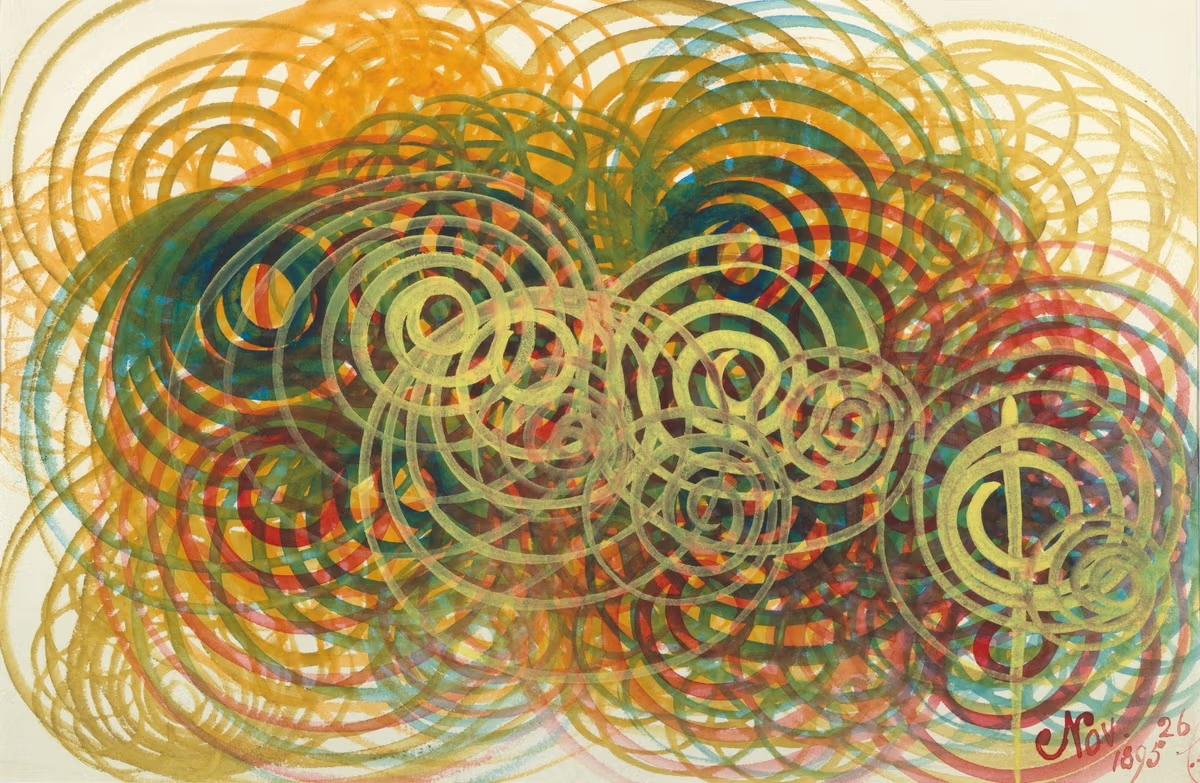
- The only surviving work: Her sole surviving creation is a watercolor on paper titled Shewing the Influence of Osiris (1895). Characterized by enigmatic geometric shapes and colored circles, the painting is housed in London at The College of Psychic Studies. [4, 6, 7]
- Museum Recognition: Long overshadowed in art history, Alice Essington Nelson has recently been rediscovered and celebrated in major international exhibitions dedicated to women in abstract art, such as the renowned exhibition Elles font l’abstraction at the Centre Pompidou in Paris and the Guggenheim in Bilbao. [4, 8]
Her Involvement in World War I
In addition to her artistic work, during World War I she served as a volunteer assistant at the Princess Louise’s Convalescent Home for Nursing Sisters in Hardelot, France. In her diaries and personal writings, now preserved at the Imperial War Museum, she documented with great empathy the hardships of the nurses and the resilience of the wounded soldiers at the front. [9, 10]
The London Spiritualist Alliance (LSA) was one of the most influential and fascinating organizations in the esoteric and cultural landscape of Victorian London. Formally founded in 1884 by the Anglican reverend and medium William Stainton Moses together with the journalist Edmund Dawson Rogers, it was established with the goal of studying mediumistic phenomena and the survival of the soul after death in a serious, structured, and non-dogmatic manner. [1, 2, 3]
The Alliance quickly became a hub for intellectuals, scientists, and artists of the time (including the scientist Alfred Russel Wallace and, later, the writer Sir Arthur Conan Doyle, who became its president in 1925). [4, 5]
Here are the main aspects linking the LSA to the history and art of that period:
🌟 1. The connection to mediumistic and abstract art
For women of the time such as Alice Essington Nelson or Georgiana Houghton, the LSA represented a unique space for free expression. In Victorian society, educated women faced significant barriers in the world of academic art. Within the Alliance, however, mediumship conferred spiritual authority upon them:
- Through automatic painting, the artist did not seek to express her own “self” (an act considered inappropriate for a woman at the time), but presented herself as a channel or instrument of higher powers.
- This willingness to be guided led to the emergence of entirely new visual forms—geometric and abstract (such as the spirals in Nelson’s work, Shewing the Influence of Osiris)—which anticipated by decades the historic avant-garde movements of Kandinsky and Kupka.
📰 2. The magazine Light
The LSA inherited and published the famous magazine Light: A Journal of Psychical, Occult, and Mystical Research (founded in 1881). This weekly publication was the true cultural driving force behind the movement: it featured heated debates, reviews of “spirit art” exhibitions, accounts of séances, and in-depth articles on parapsychology, attracting distinguished contributors from the literary and scientific worlds. [2, 6]
🏛️ 3. The Evolution: The College of Psychic Studies
The London Spiritualist Alliance did not disappear, but evolved. In 1925, it moved to its prestigious headquarters in South Kensington, and in 1970, it officially changed its name to The College of Psychic Studies. Today, the institute is a nonprofit organization that maintains a rich esoteric library, organizes courses and conferences, and houses the only surviving watercolor by Alice Essington Nelson, preserving the memory of these pioneers. [5, 7, 8, 9]
Shewing the Influence of Osirisis a watercolor on paper created on November 26, 1895 by Alice Essington Nelson. The work is of fundamental historical importance as it constitutes the only surviving artistic work by the British painter. [1, 2]
Today, the watercolor is housed in London in the permanent collection of The College of Psychic Studies, formerly the London Spiritualist Alliance, of which the artist herself was a member. [3, 4, 5]
Characteristics of the Work
- Structure and Symbolism: Visually, the work departs from the traditional landscapes of the era to embrace a pioneering geometric abstraction. It is characterized by an enigmatic composition of colored spirals and circles. In Spiritualist symbolism, the spiral represents cosmic evolution and the journey of the soul. [2, 4, 6, 7]
- The Egyptian Inspiration: The title directly evokes Osiris, the Egyptian god of the afterlife and rebirth. In the late-Victorian esoteric context, the figure of Osiris was channeled as the otherworldly force and spiritual source that dictated the work’s inspiration. [2, 4, 7]
- A “Mental Horoscope”: The artist herself described the painting as a mental horoscope. [1]
The Method of Automatic Painting
The most extraordinary aspect of Shewing the Influence of Osiris lies in its creative process. Essington Nelson claimed to have executed the painting through automatic painting (or mediumistic painting). [2, 4]
Influenced by pioneers of spiritualism such as Georgiana Houghton, Nelson painted while in a state of parapsychic trance: her hand was not guided by conscious will or academic training, but rather by impulses and energy flows directed by spirits. [2, 6, 7]
The Critical Rediscovery
For over a century, the work remained confined to private archives related to parapsychology. Recently, art historians and major institutions have rediscovered it as one of the very earliest examples of abstract art in Europe, effectively anticipating the geometric and spiritual theories of Wassily Kandinsky. The watercolor has been loaned to prestigious international exhibitions, including Elles font l’abstraction at the Centre Pompidou in Paris and the Guggenheim in Bilbao. [7]
_____________________________________
Alice Essington Nelson (1846–1921) è stata un’artista britannica pioniera dell’arte astratta, nota per il legame profondo tra la sua produzione artistica e lo spiritualismo. Nata a Cheltenham, ha vissuto gran parte della sua vita immersa nei movimenti parapsichici ed esoterici dell’epoca vittoriana ed edoardiana. [1, 2]
Il legame con lo spiritualismo e l’arte
In seguito a tragici eventi personali—la perdita prematura del figlio neonato e la morte del marito William Essington Nelson—l’artista cercò conforto nel soprannaturale. Nel 1889 si unì alla Society for Psychical Research e successivamente alla London Spiritualist Alliance, frequentata anche da figure del calibro di Arthur Conan Doyle. [2]
Da quel momento, a partire dal 1895, trovò nell’arte astratta e geometrica lo strumento ideale per esprimere le sue visioni dell’aldilà. Definiva la propria tecnica come una forma di scrittura o pittura automatica, guidata interamente da impulsi medianici e parapsichici. [3, 4, 5]
Opere e riscoperta recente
- L’unica opera superstite: La sua sola creazione giunta fino a noi è l’acquarello su carta intitolato Shewing the Influence of Osiris (1895). Caratterizzato da forme geometriche enigmatiche e cerchi colorati, il dipinto è custodito a Londra presso The College of Psychic Studies. [4, 6, 7]
- Riconoscimento museale: Rimasta a lungo nell’ombra della storia dell’arte, la figura di Alice Essington Nelson è stata recentemente riscoperta e celebrata in importanti mostre internazionali dedicate alle donne dell’astratto, come la celebre esposizione Elles font l’abstraction al Centre Pompidou di Parigi e al Guggenheim di Bilbao. [4, 8]
L’impegno nella Prima Guerra Mondiale
Oltre alla sua attività artistica, durante la Prima Guerra Mondiale lavorò come assistente volontaria presso la Princess Louise’s Convalescent Home for Nursing Sisters a Hardelot, in Francia. Nei suoi diari e scritti personali, oggi conservati all’Imperial War Museum, documentò con grande empatia le fatiche delle infermiere e la resilienza dei soldati feriti al fronte. [9, 10]
La London Spiritualist Alliance (LSA) è stata una delle organizzazioni più influenti e affascinanti del panorama esoterico e culturale della Londra vittoriana. Fondata formalmente nel 1884 dal reverendo anglicano e medium William Stainton Moses insieme al giornalista Edmund Dawson Rogers, nacque con l’obiettivo di studiare i fenomeni medianici e la sopravvivenza dell’anima dopo la morte in modo serio, strutturato e privo di dogmatismi. [1, 2, 3]
L’alleanza divenne rapidamente un punto di riferimento per intellettuali, scienziati e artisti dell’epoca (tra cui lo scienziato Alfred Russel Wallace e, in seguito, lo scrittore Sir Arthur Conan Doyle, che ne divenne presidente nel 1925). [4, 5]
Ecco gli aspetti principali che collegano la LSA alla storia e all’arte di quel periodo:
🌟 1. Il legame con l’arte medianica e astratta
Per donne dell’epoca come Alice Essington Nelson o Georgiana Houghton, la LSA rappresentava uno spazio di libertà espressiva unico. Nella società vittoriana, le donne colte incontravano forti barriere nel mondo dell’arte accademica. All’interno dell’Alleanza, invece, la medianicità conferiva loro un’autorità spirituale:
- Attraverso la pittura automatica, l’artista non pretendeva di esprimere il proprio “io” (atto considerato all’epoca poco consono per una donna), ma si presentava come un canale o uno strumento di forze superiori.
- Questo lasciarsi guidare portò alla nascita di forme visive totalmente nuove, geometriche e astratte (come le spirali dell’opera di Nelson, Shewing the Influence of Osiris), che anticiparono di decenni le avanguardie storiche di Kandinskij e Kupka.
📰 2. La rivista Light
La LSA ereditò e pubblicò la celebre rivista Light: A Journal of Psychical, Occult, and Mystical Research (fondata nel 1881). Questa pubblicazione settimanale era il vero motore culturale del movimento: ospitava dibattiti accesi, recensioni di mostre di “arte degli spiriti”, resoconti di sedute spiritiche e approfondimenti di parapsicologia, attirando firme illustri del panorama letterario e scientifico. [2, 6]
🏛️ 3. L’evoluzione: Il College of Psychic Studies
La London Spiritualist Alliance non è scomparsa, ma si è evoluta. Nel 1925 si trasferì nella prestigiosa sede di South Kensington e, nel 1970, cambiò ufficialmente nome in The College of Psychic Studies. Oggi l’istituto è un’organizzazione benefica che conserva una ricchissima biblioteca esoterica, organizza corsi e conferenze e custodisce l’unico acquerello superstite di Alice Essington Nelson, proteggendo la memoria di queste pioniere. [5, 7, 8, 9]
Shewing the Influence of Osirisè un acquarello su carta realizzato il 26 novembre 1895 da Alice Essington Nelson. L’opera è di fondamentale importanza storica poiché costituisce l’unica testimonianza artistica superstite della pittrice britannica. [1, 2]
Oggi l’acquarello è custodito a Londra nella collezione permanente del The College of Psychic Studies, l’ex London Spiritualist Alliance di cui l’artista stessa faceva parte. [3, 4, 5]
Caratteristiche dell’opera
- Struttura e Simbologia: Visivamente l’opera si distacca dai paesaggi tradizionali dell’epoca per abbracciare un’astrazione geometrica precorritrice. È caratterizzata da una composizione enigmatica di spirali e cerchi colorati. Nella simbologia spiritualista la spirale rappresenta l’evoluzione cosmica e il viaggio dell’anima. [2, 4, 6, 7]
- L’ispirazione egizia: Il titolo evoca direttamente Osiride, il dio egizio dell’aldilà e della rinascita. Nel contesto esoterico tardo-vittoriano, la figura di Osiride veniva canalizzata come la forza ultraterrena e la fonte spirituale che dettava l’ispirazione dell’opera. [2, 4, 7]
- Un “Oroscopo Mentale”: L’artista stessa descrisse il dipinto come un mental horoscope (oroscopo mentale). [1]
Il metodo della Pittura Automatica
La particolarità più straordinaria di Shewing the Influence of Osiris risiede nel suo processo creativo. Essington Nelson dichiarò di aver eseguito il dipinto attraverso la pittura automatica (o medianica). [2, 4]
Influenzata da pioniere dello spiritualismo come Georgiana Houghton, la Nelson dipingeva in uno stato di trance parapsichica: la sua mano non era guidata dalla volontà cosciente o da studi accademici, bensì da impulsi e flussi di energia guidati dagli spiriti. [2, 6, 7]
La riscoperta critica
Per oltre un secolo l’opera è rimasta confinata negli archivi privati legati alla parapsicologia. Di recente, storici dell’arte e grandi istituzioni l’hanno riscoperta come uno dei primissimi esempi di arte astratta in Europa, anticipando di fatto le teorie geometriche e spirituali di Wassily Kandinsky. L’acquarello è stato esposto in prestito in prestigiose mostre internazionali, tra cui Elles font l’abstraction al Centre Pompidou di Parigi e al Guggenheim di Bilbao. [7]
[1] https://skepticalinquirer.org
[2] https://fromtheheartofeurope.eu
[4] https://www.artnewspaper.fr
[6] https://ombrelles.hypotheses.org
[1] https://www.encyclopedia.com
[2] https://psi-encyclopedia.spr.ac.uk
[5] https://www.collegeofpsychicstudies.co.uk
[6] https://www.arthur-conan-doyle.com
[7] https://www.collegeofpsychicstudies.co.uk
[8] https://www.encyclopedia.com
[9] https://www.collegeofpsychicstudies.co.uk
[3] https://www.artnewspaper.fr
[5] https://fromtheheartofeurope.eu
[6] https://www.artnewspaper.fr
[7] https://vivienneroberts.com

