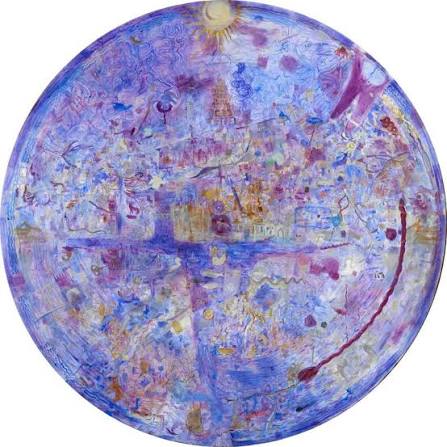
Among today’s British artists exploring the symbolic dimension of landscape, Andrea McLean occupies a distinctive position. Rather than depicting physical geography, her paintings evoke an inner cartography—maps of memory, myth, pilgrimage and consciousness. Her work stands at the intersection of sacred art, visionary imagination and the long Western tradition of symbolic cosmography.
Born in 1968 and based in Herefordshire, McLean studied at the Falmouth School of Art before completing postgraduate studies at the Slade School of Fine Art. She was awarded an Abbey Scholarship at the British School at Rome, an experience that deepened her engagement with the relationship between landscape, history and sacred space. She later served as Artist-in-Residence at Gloucester Cathedral and is now a faculty tutor at the Royal Drawing School in London.
The Return of the Mappa Mundi
One of the defining themes of McLean’s work is the reinvention of the medieval Mappa Mundi. Unlike modern maps, medieval cosmographies were not designed primarily for navigation. They described a meaningful universe in which geography, theology, mythology and human destiny formed an integrated whole.
McLean revives this forgotten tradition by creating paintings that resemble maps while refusing literal geography. Cities become symbols, rivers become psychological currents, and pathways unfold as spiritual journeys. Her celebrated Mappa Mundi, now in the collection of the British Library, exemplifies this dialogue between medieval imagination and contemporary consciousness.
William Blake and the Visionary Imagination
William Blake represents one of McLean’s most important artistic and spiritual references. She has produced work for the Blake Society, teaches courses on Blake at the Royal Drawing School, and frequently returns to his understanding of imagination as a mode of perception rather than fantasy.
Like Blake, McLean approaches artistic creation as an act of revelation. The visible world is only the threshold of a deeper reality populated by symbols, archetypes and invisible relationships. Her paintings do not illustrate myths; they invite viewers to enter a mythic mode of seeing.
Mapping Inner Landscapes
The language of mapping has become McLean’s visual vocabulary. Labyrinths, concentric cities, bridges, towers, pathways and circular forms recur throughout her paintings, suggesting movement through psychological and spiritual territories rather than physical space.
She has described drawing as a process that naturally develops into imaginary cities, diagrams and cosmographies—a way of discovering “the bigger picture” through visual thought.
This approach resonates strongly with the symbolic tradition found in many esoteric schools, where maps function as representations of consciousness itself. The journey across a landscape mirrors the journey through the soul.
Sacred Space Beyond Religion
Although McLean has worked extensively within ecclesiastical contexts—including Gloucester Cathedral and Hereford Cathedral—her vision is not confined to institutional religion. Her paintings explore universal questions concerning order, memory, imagination and humanity’s place within the cosmos.
In recent years she has spoken and exhibited at the Pari Centre in Tuscany, a venue known for interdisciplinary dialogue between science, philosophy and spirituality. Her recent exhibitions, including Mythos (2023) and Kosmos (2026), reflect an increasing emphasis on cosmological symbolism and the threshold between visible and invisible worlds.
Art as Cosmography
From the perspective of Theosophy, McLean’s paintings may be understood as contemporary cosmographies. Rather than illustrating specific doctrines, they recover an ancient intuition: that the universe possesses both outer form and inner meaning.
Theosophical thinkers such as Helena P. Blavatsky, Annie Besant and Geoffrey Hodson often described symbols as living bridges between levels of consciousness. McLean’s visual language operates in a comparable way. Her maps are not destinations but invitations—portals encouraging contemplative participation rather than intellectual explanation.
Conclusion
In an age dominated by satellite imagery, digital navigation and measurable space, Andrea McLean reminds us that another form of cartography remains possible. Her paintings chart not continents but consciousness; not political borders but symbolic relationships.
They suggest that the oldest function of art may still be among its most necessary: to help us orient ourselves within the invisible landscape of the human spirit.
 Theosophy & ARTS